.webp)
Overview
India now runs on E20 petrol, and the national conversation has moved well past blending targets. Yet a stubborn set of ethanol myths refuses to retire.
This piece takes eight of the most repeated claims and checks each one against BIS standards, government notifications and actual industry production data. Some are outdated. Some are backwards. One or two carry a grain of truth worth naming honestly.
Why These Beliefs Refuse to Die
Ethanol moved from a niche additive to a national fuel in under a decade. That speed created a gap. Policy and production ran ahead of public understanding, and into that gap poured forwarded messages, roadside workshop advice and half-remembered headlines.
Most ethanol myths are not inventions. They are expired truths. Something that was genuinely accurate about a 2012 carburettor motorcycle gets repeated about a 2026 BS6 car, and it quietly stops being true somewhere along the way. Separating the two is the entire job here.
Myth 1. Ethanol Blended Petrol Destroys Your Engine
This is the most widespread of all ethanol myths, and it has a real kernel buried inside it.
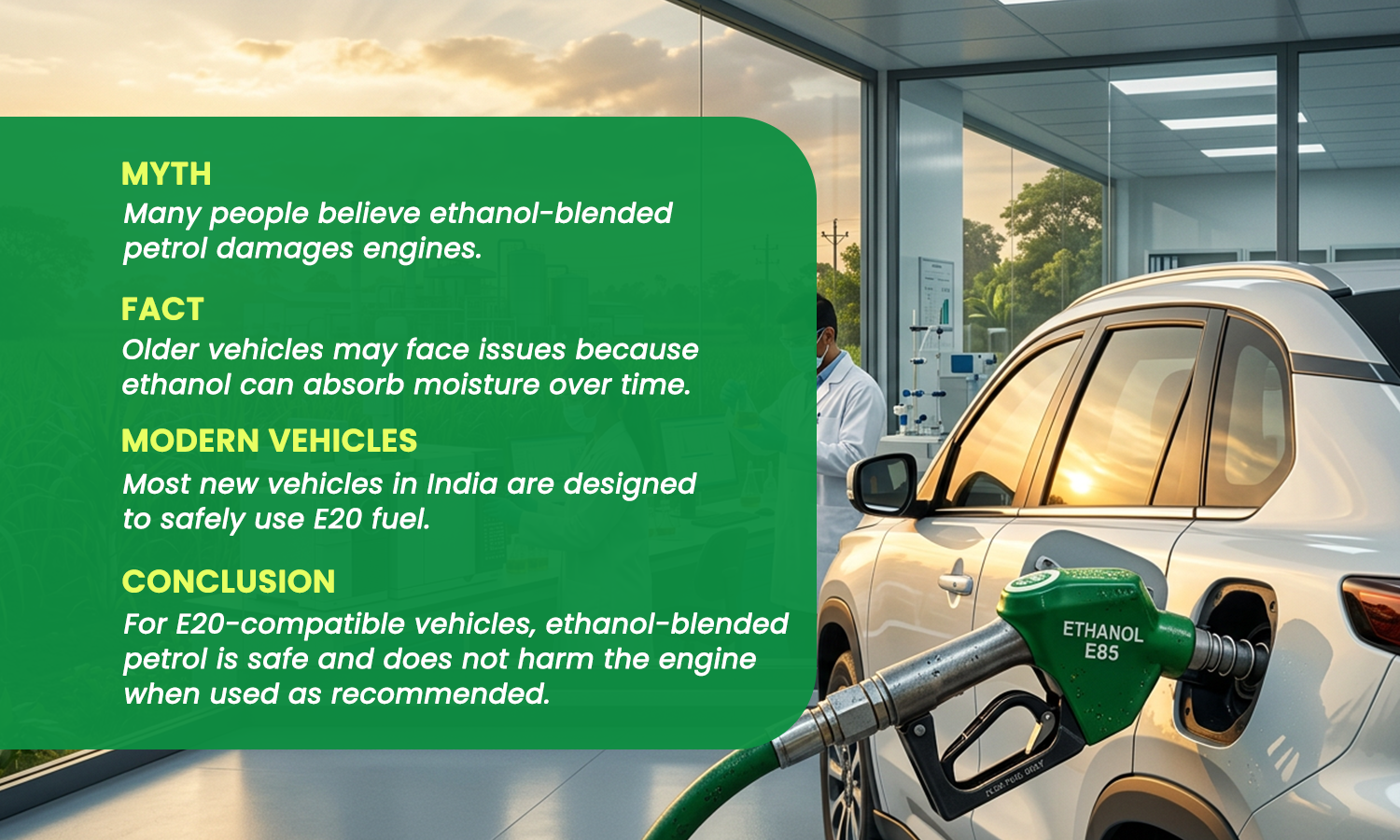
Ethanol is hygroscopic, which means it pulls moisture from the air. In older fuel systems, that moisture combined with ethanol's mild solvency could degrade certain rubber seals, hoses and fuel lines over long periods. The engineering concern behind the claim that ethanol mixed petrol is harmful for vehicles is a legitimate one.
What changed is the hardware. Vehicles sold in India today are built with E20-compatible fuel systems using corrosion-resistant components rated for the blend. For these vehicles, the question of whether ethanol in petrol is good or bad has a clear answer. The fuel sits within specification and the engine was designed around it.
The honest caveat belongs to much older vehicles built before E20 compatibility became standard. Owners of vintage two-wheelers and ageing cars should follow manufacturer guidance rather than assume. That is a maintenance question, not a verdict on the fuel.
Myth 2. Ethanol Wrecks Your Mileage
Of all the ethanol myths, this is the one with the most real chemistry behind it. Ethanol carries less energy per litre than petrol, which is why ethanol vs petrol calorific value is a genuine search. A litre of E20 does hold slightly less energy than a litre of pure petrol.
The leap from that fact to a collapse in fuel economy is where this myth lives. At E20, the efficiency difference is modest and frequently disappears inside the ordinary variation caused by tyre pressure, traffic, load and driving style. Alarm about ethanol blended petrol mileage is not supported by the blend India actually runs on.
At far higher blends, the effect becomes real and deserves naming. Reporting on E100 points to a mileage drop in the region of 27 to 30 percent. Which is exactly why pricing has been engineered alongside it. E85 has been signalled at roughly twenty rupees per litre below petrol, a gap built to absorb the efficiency difference at the pump rather than pass it to the driver.
Myth 3. Ethanol Takes Food Off the Plate
The food versus fuel argument is the most emotionally loaded of the ethanol myths, and it deserves a serious answer rather than a wave of the hand.
India's programme deliberately diversified its feedstock. Data released by the All India Distillers' Association shows maize has emerged as the single largest feedstock, moving ahead of traditional sugarcane-based sources. Damaged and surplus grain with no premium food market also feeds the system.
There is a second-order effect worth sitting with. Ethanol has become a price floor. A cane or maize grower with a guaranteed second buyer is in a materially stronger negotiating position than one without.
Myth 4. India Does Not Have Enough Ethanol
Among the ethanol myths in circulation, this one is almost precisely backwards.
India's distilling industry has built a capacity of roughly 2,000 crore litres. Actual utilisation has been running nearer 1,200 crore litres. The country's problem has never been making ethanol. It has been finding enough places to put it.
That surplus is the reason AIDA has pressed for higher blends, flex fuel vehicles, ethanol in aviation and ethanol as a cooking fuel. Most of the ethanol-blended petrol disadvantages conversation quietly assumes scarcity. The real constraint has been sitting on the demand side all along.
Myth 5. Ethanol Is Only Useful in Petrol
Petrol was the entry point. It is no longer the boundary, and few ethanol myths date as badly as this one.
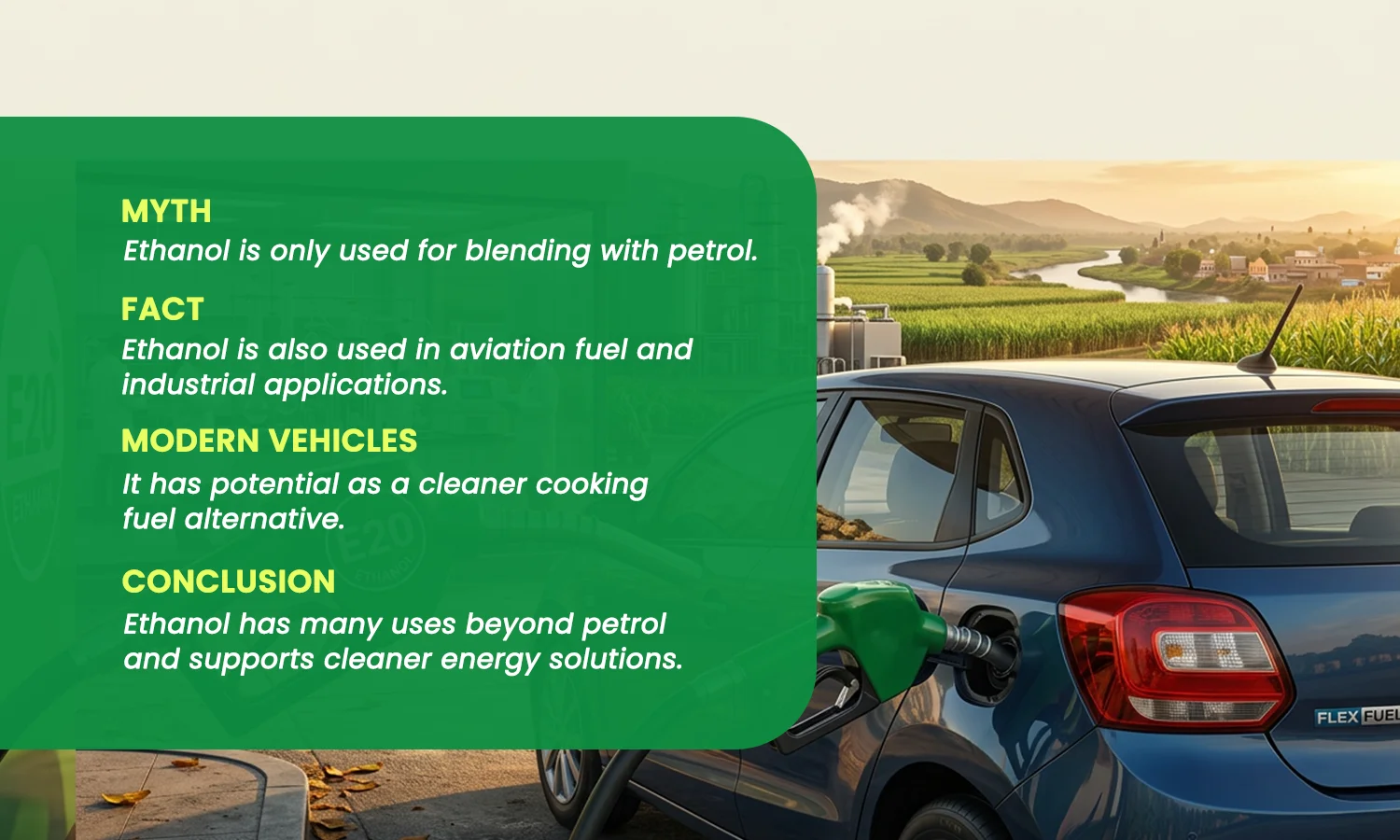
In April 2026, India approved the alcohol to jet pathway, allowing ethanol-derived sustainable aviation fuel to be blended into aviation turbine fuel under ASTM D7566 certification. AIDA has separately written to the Ministry of Petroleum and Natural Gas urging a nationwide rollout of ethanol-based cooking as an alternative to LPG. Ethanol in diesel blends and ethanol-powered generators are both under active discussion.
Myth 6. Ethanol Is a Subsidy Experiment That Will Fade
Policy says otherwise, and it says it loudly. The Bureau of Indian Standards has notified specifications for higher blends at E22, E25, E27 and E30. CAFE III efficiency norms are set to reshape what automakers build. E85 and E100 have been given legal recognition through amendments to the Central Motor Vehicles Rules, opening the road to flex fuel vehicles from four-wheeler and two-wheeler manufacturers alike.
Those are not the moves of a government hedging its bets. Talk of ethanol fuel disadvantages ending the programme has been overtaken by the notifications themselves.
Myth 7. Ethanol Is Dirty to Produce
This is one of the ethanol myths built on a memory of what a distillery used to be. Modern Indian distilleries operate under zero liquid discharge requirements. AIDA actively promotes ZLD, renewable energy integration, bio CNG and the circular use of distillery by-products, and runs a Technical Committee focused on effluent treatment and energy optimisation. The distillery of public imagination and the distillery of 2026 are not the same building.
Myth 8. You Can Still Easily Buy Ethanol-Free Petrol
Searches for petrol without ethanol in India remain stubbornly high. The practical answer is that E20 is now the standard grade sold across the country. Anyone asking how much ethanol petrol in India is looking at a national blend, not a pump-by-pump lottery. Hunting for a station that quietly dispenses something else is chasing a fuel the market has already moved past, and it is the last of our ethanol myths to fall.
Myths and Facts at a Glance
Eight ethanol myths, set against what the standards, notifications and production data actually show.
| The Claim | What the Evidence Says |
| Ethanoldestroysengines | Vehicles sold in India today use E20-compatible, corrosion-resistant fuel systems. Pre-E20 vehicles should follow manufacturer guidance. |
| Mileage collapses on E20 | The efficiency difference at E20 is modest. The 27 to 30 percent figure belongs to E100, and E85 pricing is set roughly ₹20 below petrol to offset it. |
| Ethanol steals food | AIDA data shows maize has overtaken sugarcane as the largest feedstock. Damaged and surplus grain also feeds the system. |
| India lacks ethanol | Capacity sits near 2,000 crore litres against utilisation nearer 1,200 crore litres. The gap is demand, not supply. |
| Ethanol stops at petrol | The alcohol to jet pathway for aviation fuel is approved. Cooking fuel and diesel blending are under active discussion. |
| It is a passing subsidy | BIS has notified E22 to E30. CAFE III is coming. E85 and E100 carry legal recognition under the amended CMVR |
| Distilleries pollute | Zero liquid discharge, bio CNG and circular by-product use are now standard practice across the sector. |
| Ethanol-free petrol is easy to find | E20 is the national standard grade for petrol sold in India. |
Key Takeaways
- Most ethanol myths are expired truths, accurate about older vehicles and repeated about modern ones.
- Every vehicle sold in India today is built for E20. The engine damage fear, the oldest of the ethanol myths, belongs to a previous generation of hardware.
- The mileage question is real only at very high blends, and E85 pricing is designed to absorb it.
- Maize has overtaken sugarcane as India's largest ethanol feedstock, according to AIDA data.
- India's ethanol challenge is surplus, not shortage. Capacity near 2,000 crore litres sits against utilisation nearer 1,200 crore litres.
- BIS standards to E30, CAFE III norms, E85 and E100 recognition and the alcohol to jet pathway all point one direction
Frequently Asked Questions
Is ethanol in petrol good or bad for my car?
For any vehicle sold in India in recent years, it is fine. These vehicles are built with E20-compatible fuel systems. The caution applies to much older vehicles, where the manufacturer's guidance should be followed.
How much ethanol is in petrol in India right now?
E20 is the standard grade, meaning twenty percent ethanol blended into petrol. India reached this milestone ahead of its original target.
Does ethanol-blended petrol actually reduce mileage?
At E20 the difference is small and often lost inside normal variation from traffic, load and driving style. The substantial drop of 27 to 30 percent that gets quoted applies to E100, not the fuel in your tank today.
Can a BS6 engine run on ethanol?
Yes. BS6 vehicles sold in India are designed for E20. Running on higher blends such as E85 or E100 requires a flex fuel vehicle, which is a different category of engine and fuel system.
Why do ethanol myths spread so easily?
Because the fuel changed faster than the conversation did, claims that were accurate about older engines and lower-grade fuel systems kept circulating long after the hardware and the standards moved on.
Are the disadvantages of ethanol-blended petrol serious enough to avoid it?
For a compatible vehicle, no. The trade-offs are modest, and the fuel is within specification. The genuine disadvantages people cite tend to describe either very old vehicles or very high blends, and neither describes standard E20 in a modern car.
Move past the ethanol myths. Get the facts from the industry that makes the fuel.
The All India Distillers' Association has been the apex national body for India's ethanol and distillery sector since 1953, and is the only association recognised by the Government of India representing grain-based and molasses-based ethanol producers alongside potable alcohol manufacturers.
For verified production data, policy briefings and the industry's position on India's blending roadmap, visit aidaindia.org.