
.webp)
Overview
Ethanol production in India has gone from a modest sideline of the sugar trade to a national energy mission. The country lifted distillation capacity to roughly 1,822 crore litres a year across 499 sites by mid 2025, enough to put a fifth of the petrol supply on a crop-based footing. As the apex distillers' body since 1953, the All India Distillers Association (AIDA)
represents the producers at the centre of this change. Here is how the sector scaled so quickly and what holds it together.
How ethanol production works, start to finish?
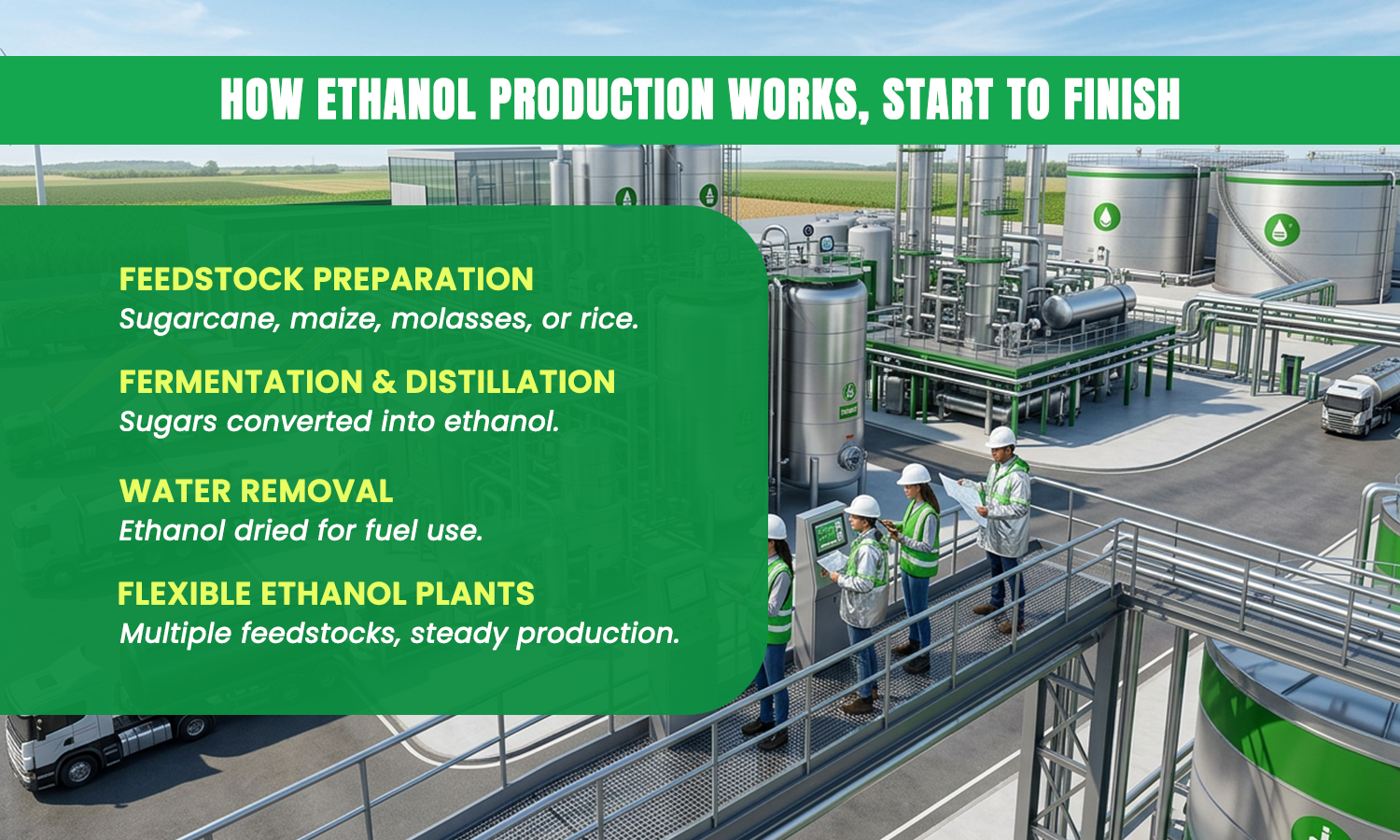
Ethanol production follows three stages: preparing the feedstock, fermenting its sugars and distilling the alcohol. Yeast turns sugar into raw alcohol, distillation columns concentrate it, then a drying step removes the last traces of water for fuel use.
The site that does this work, the ethanol plant, is usually built to handle several feedstocks at once. A flexible ethanol plant can swing between sugarcane juice, molasses, maize and rice depending on cost and availability, which keeps output steady through the year.
Ethanol production in India: feedstocks and the maize shift
Ethanol production in india once depended almost entirely on sugarcane and its molasses. That has changed sharply, with grain-based output now leading and maize alone supplying close to half the fuel ethanol in Ethanol Supply Year 2024 to 2025.
This rebalancing makes ethanol production in India less exposed to a poor cane season, since grain can fill the gap. A purpose-built ethanol production plant for grain can run all year, while a modern ethanol production plant with dual feed hedges across both routes.
Ethanol supply and distribution to oil companies
Once distilled, the alcohol enters ethanol supply contracts with the public oil companies, which buy fixed volumes each year at administered prices. Predictable ethanol supply is what lets refiners hit blending targets without disruption.
Then comes ethanol distribution, moving the alcohol by road and rail tankers from plant to depot. Reliable ethanol distribution across long distances is the unglamorous backbone of the whole programme, since fuel cannot be mixed where it has not arrived.
The government subsidy behind the surge
Much of the recent growth rests on a clear government subsidy for ethanol production in india. Under an interest subvention scheme, the government covers part of the interest on loans taken to build or expand a distillery, lowering the cost of fresh capacity.
The government subsidy for ethanol production in india typically covers 6 percent of interest, or half the bank rate, for five years with a one-year moratorium, provided the site meets pollution norms and supplies most output to oil companies. That backing turned a policy target into a wave of new capacity.
Why renewable production matters for the long run?
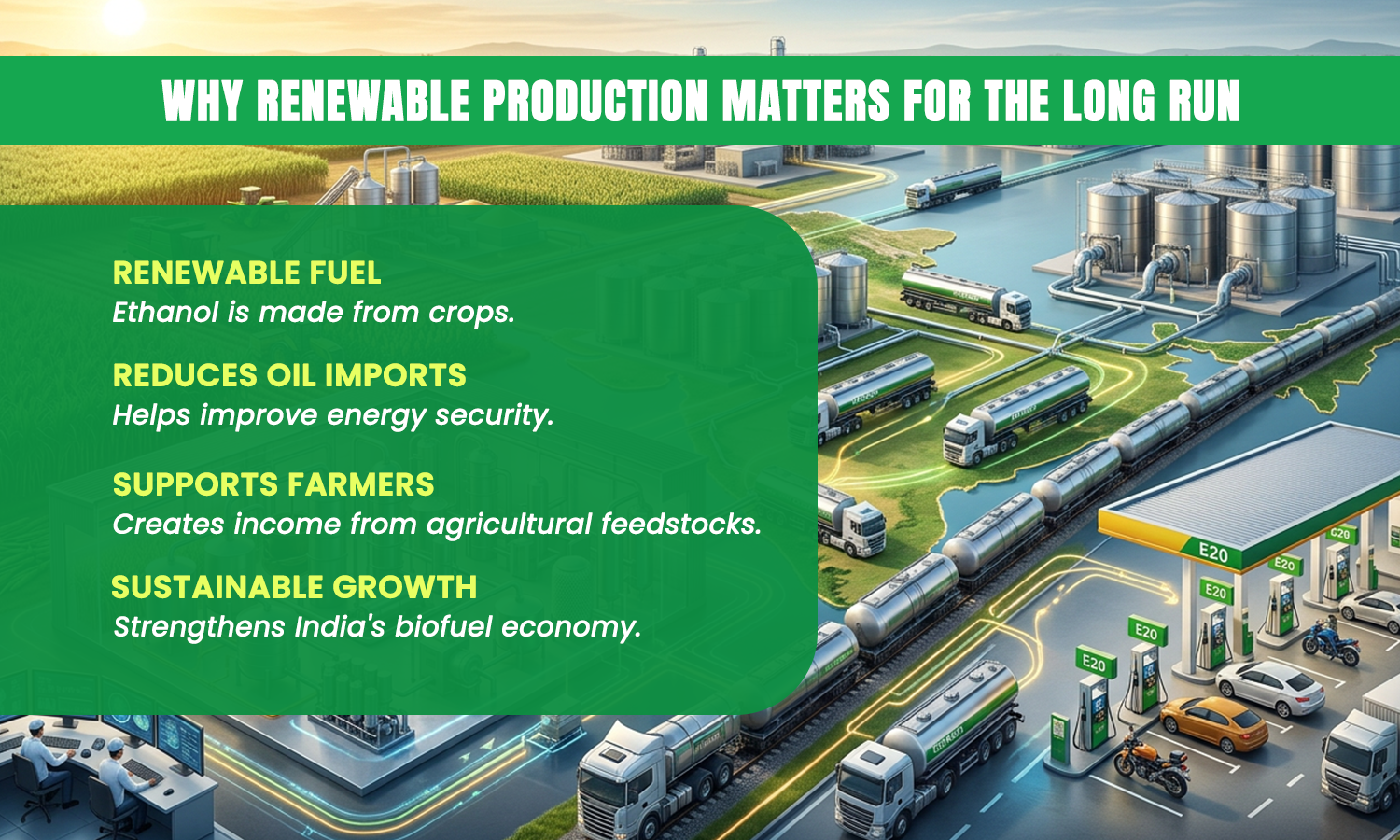
Because the alcohol is made from crops, this is renewable ethanol, produced from feedstocks that regrow each season rather than from finite oil. Scaling renewable ethanol is what lets the country cut crude imports while supporting farm incomes at the same time.
Over eleven years, the programme saved more than Rs 1.6 lakh crore in foreign exchange and paid over Rs 1.4 lakh crore to farmers, per figures shared in Parliament in December 2025. Those numbers are the real return on India's investment in ethanol production.
India reached E20. What comes next? Explore the evolving ethanol industry and the future of biofuels with the All India Distillers’ Association.
KEY TAKEAWAYS
- Ethanol production in India scaled to about 1,822 crore litres of capacity across 499 distilleries by mid 2025.
- It runs in three stages: feedstock prep, fermentation and distillation, often in multi-feed plants.
- Ethanol production in India shifted toward grain, with maize supplying close to half of fuel ethanol in 2024 to 2025.
- A government interest subvention covering about 6 percent of loan interest funded much of the build-out.
- Because it is renewable, scaled output cut crude imports and paid farmers over Rs 1.4 lakh crore in eleven years.
FREQUENTLY ASKED QUESTIONS
Q1. How does ethanol production work in India?
Ethanol production in India involves preparing a feedstock such as sugarcane or maize, fermenting its sugars with yeast, then distilling and drying the alcohol. Sugar-based and grain-based routes both operate, often inside a single multi-feed ethanol plant. The finished anhydrous alcohol is then supplied to oil companies for blending into petrol.
Q2. How much has ethanol production in India grown?
Ethanol production in India has grown dramatically, with installed capacity reaching about 1,822 crore litres a year across 499 distilleries by mid 2025. This expansion, split across molasses-based, grain-based and dual-feed plants, allowed the country to reach 20 percent blending roughly five years ahead of the original 2030 target.
Q3. Is there government support for ethanol production?
Yes, a government subsidy for ethanol production in India operates through an interest subvention scheme. It covers about 6 percent of loan interest, or half the bank rate, for five years including a one-year moratorium. Plants must meet pollution norms and supply most of their output to oil companies to qualify for this support.
Q4. What feedstocks are used for ethanol production in India?
Ethanol production in India uses sugarcane juice, B-heavy and C-heavy molasses, maize, broken rice and surplus food grains. Maize has become the single largest source, supplying close to half of fuel ethanol in Ethanol Supply Year 2024 to 2025. This mix makes renewable production less dependent on any one crop.
ABOUT AIDA
AIDA, the All India Distillers' Association, has been the voice of Indian distilleries since 1953 and is recognised as the apex national body for ethanol, bioenergy and potable alcohol. Its members hold more than 80 percent of the country's distillation capacity. Read more across the cluster at aidaindia.org.