
Key Takeaways
- India’s ethanol production process now supports nationwide E20 fuel rollout.
- Maize contributes over 45% of India’s ethanol feedstock supply.
- Modern distilleries recycle water through Zero Liquid Discharge systems.
- India’s ethanol capacity has expanded from 380 million liters in 2014 to nearly 20 billion liters today.
- The All India Distillers’ Association (AIDA) is helping shape India’s move toward E30 and flex-fuel mobility.
India’s fuel story is changing fast. Petrol pumps across the country now supply E20 fuel, meaning every Liter of petrol contains 20% ethanol. Behind this transition lies a rapidly expanding ethanol production process that connects farmers, distilleries, policymakers, and fuel companies into one large domestic energy ecosystem.
The growth of ethanol production in India is not only about cleaner fuel. It is also about reducing crude oil imports, strengthening rural income, and building long-term energy security. India imports nearly 87% of its crude oil needs. Replacing even a part of that with domestic bioethanol production creates major economic value within the country.
Today, India’s distilleries use sugarcane, maize, broken rice, and damaged food grains as the main raw material for ethanol production. This diversified system allows fuel production to continue across seasons while supporting farmers and reducing agricultural waste.
As the apex national body representing grain-based and molasses-based distillers, the All India Distillers’ Association continues to support the expansion of a cleaner and more self-reliant fuel ecosystem.
How Raw Materials Shape India’s Ethanol Ecosystem
The biggest transformation in the Indian ethanol production process has been the shift from sugar-only feedstocks to a multi-feedstock model.
A few years ago, most ethanol production companies in India depended heavily on sugarcane molasses. Today, maize has emerged as the single largest contributor to India’s ethanol supply.
India’s current feedstock mix includes:
| Feedstock | Share in Ethanol Allocation |
|---|---|
| Maize | 45.68% |
| FCI Surplus Rice | 22.25% |
| Direct Sugarcane Juice | 15.82% |
| B-Heavy Molasses | 10.54% |
| Damaged Food Grains | 4.54% |
| C-Heavy Molasses | 1.16% |
Maize has become one of the best-performing feedstocks because it has a shorter crop cycle and better water efficiency compared to paddy. It also delivers nearly 380 to 400 Liters of ethanol per tonne.
At the same time, ethanol production from sugarcane remains important because molasses already contains fermentable sugars. This reduces processing time inside the distillery.
Maize has become one of the best-performing feedstocks because it has a shorter crop cycle and better water efficiency compared to paddy. It also delivers nearly 380 to 400 liters of ethanol per tonne.
At the same time, ethanol production from sugarcane remains important because molasses already contains fermentable sugars. This reduces processing time inside the distillery.
Broken rice and damaged grains also play a major role in the production of ethanol. These grains are not suitable for human consumption, so converting them into fuel creates value from surplus agricultural stock that would otherwise remain unused.
This multi-feedstock approach has helped India move beyond seasonal fuel production and enabled distilleries to operate throughout the year.
Understanding the Ethanol Production Process Inside Distilleries
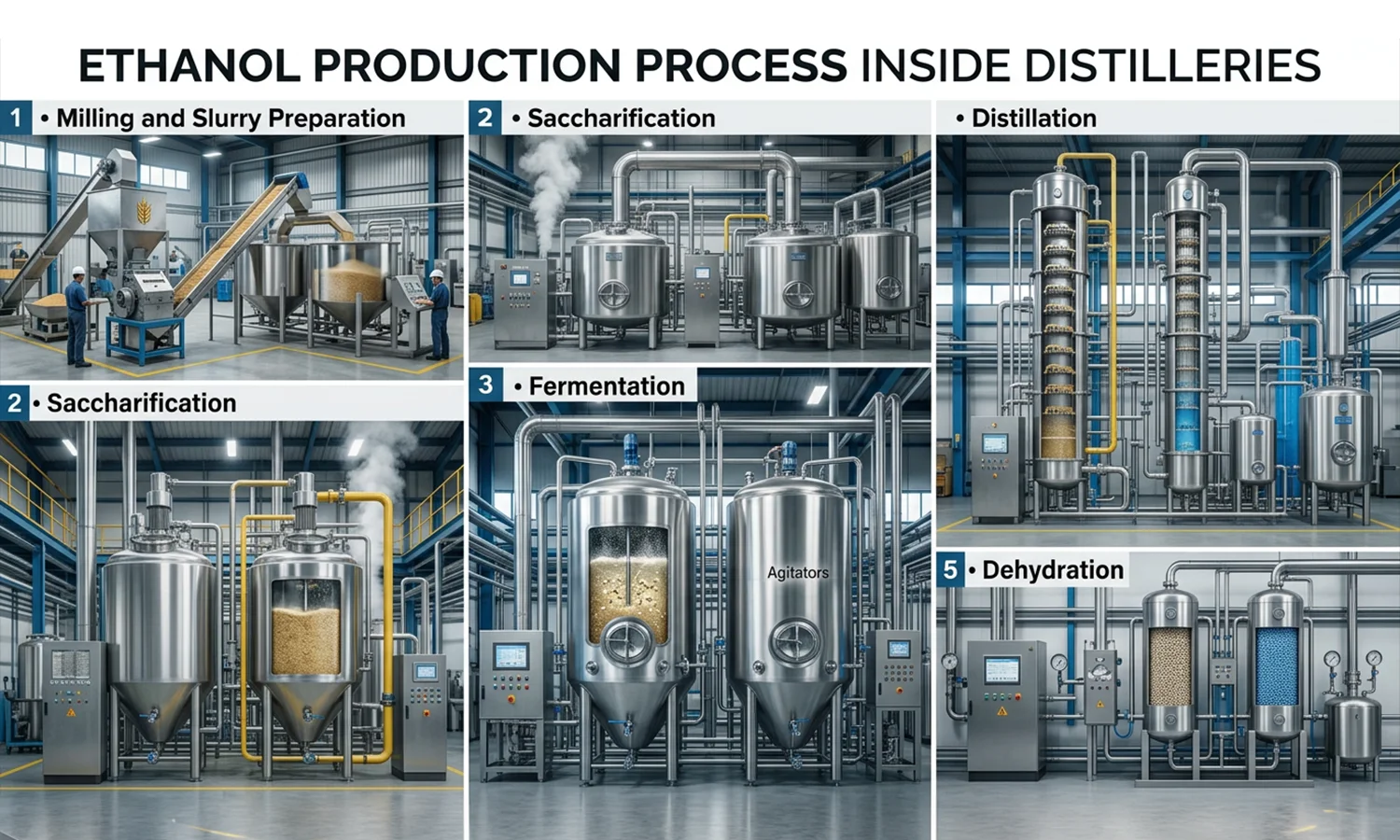
The modern ethanol production plant is highly automated and designed for continuous fuel generation.
The exact process of ethanol production changes depending on the feedstock being used.
Grain-based feedstocks like maize and broken rice require starch conversion before fermentation. Molasses-based feedstocks already contain sugar, so they skip a few early stages.
The main stages of the industrial production of ethanol include:
1. Milling and Slurry Preparation
Grains are crushed into fine powder and mixed with water to form a slurry. Enzymes are added to break down starch molecules.
2. Saccharification
Additional enzymes convert starch into simple glucose sugars that yeast can consume.
3. Fermentation
This is the heart of the microbial production of ethanol. Yeast converts sugars into alcohol and carbon dioxide over 40 to 60 hours.
4. Distillation
The fermented liquid enters distillation columns, where ethanol is separated using heat and steam.
5. Dehydration
Special molecular sieve systems remove remaining moisture to produce fuel-grade ethanol with 99.6% purity.
The final product is anhydrous ethanol ready for blending with petrol.
Modern distilleries also capture commercial carbon dioxide generated during fermentation and supply it to the food and beverage sector.
How Technology and Water Management Are Changing Ethanol Production
Water management has become one of the most important parts of the ethanol production process.
A major public debate around ethanol focuses on water usage. The discussion often mixes farm-level agricultural water with actual industrial water consumption inside distilleries.
Modern Indian distilleries typically consume only around 3 to 5 liters of process water to produce one liter of ethanol because most facilities now operate on recycling systems.
The industry is improving water efficiency at two levels.
Farm-Level Improvements
- Drip irrigation systems reduce water use by up to 40%.
- Precision farming tools monitor soil moisture and irrigation needs.
- Maize-based ethanol reduces pressure on water-intensive crops.
Distillery-Level Improvements
- Zero Liquid Discharge systems recycle wastewater internally.
- Mechanical vapor recompression systems recover steam and water.
- Condensate Polishing Units purify recovered water for reuse.
These systems ensure that the modern biofuel ecosystem functions with lower environmental stress while supporting higher fuel output.
Distilleries are also converting leftover grain residue into DDGS, a high-protein animal feed that supports poultry and dairy sectors.
Scaling Ethanol Production for India’s Future Fuel Needs
India’s fuel transition is now moving beyond E20.
The Bureau of Indian Standards has already notified specifications for E22 to E30 fuels, preparing the market for higher ethanol blends and future flex-fuel mobility.
India’s total ethanol production capacity has expanded sharply:
- 380 million liters in 2014
- Nearly 20 billion liters today
Oil marketing companies allocated over 1,048 crore liters of ethanol for the current blending cycle alone.
The next phase of the ethanol production process will focus on:
- E30 fuel expansion
- E85 and E100 standards
- Flex-Fuel Vehicles (FFVs)
- Second-generation ethanol from crop residue
- Ethanol-powered cooking fuel pilots
The long-term goal is to reduce crude oil dependence while creating a larger domestic energy economy built around Indian agriculture.
Conclusion
India’s growing ethanol production process is no longer just about blending fuel. It has become part of a larger national effort to improve energy security, strengthen rural income, reduce emissions, and create long-term economic resilience.
The shift toward multi-feedstock distillation, water recycling technologies, and higher ethanol blends shows how rapidly the sector is evolving.
At the All India Distillers’ Association, the focus continues to remain on supporting a balanced and sustainable biofuel ecosystem that connects agriculture, technology, and energy into one integrated national growth story.
FAQs
What is the ethanol production process?
The ethanol production process involves converting agricultural feedstocks like maize, molasses, and broken rice into fuel-grade ethanol through fermentation, distillation, and dehydration.
What are the main raw materials used for ethanol production in India?
The main raw materials for ethanol production include maize, sugarcane juice, molasses, surplus rice, and damaged food grains.
Why is ethanol production increasing in India?
Ethanol production in India is increasing because the country wants to reduce crude oil imports, improve energy security, and support cleaner fuel adoption through E20 and future higher blends.
How do modern ethanol plants reduce water usage?
Modern ethanol production plant systems use zero liquid discharge technology, water recycling, and steam recovery systems to minimize freshwater usage.
What is the future of ethanol fuel in India?
The future of ethanol fuel in India includes E30 fuel, flex-fuel vehicles, second-generation biofuels, and expanded domestic fuel production supported by the All India Distillers’ Association.