
Key Takeaways
- Excise duty on petrol forms a major part of retail fuel pricing.
- State VAT creates a compounding “tax-on-tax” effect
- India imports nearly 88% of its crude oil requirements.
- Ethanol blending has already saved over ₹1.63 lakh crore in foreign exchange.
- AIDA supports India’s long-term fuel self-reliance strategy through ethanol expansion.
Introduction
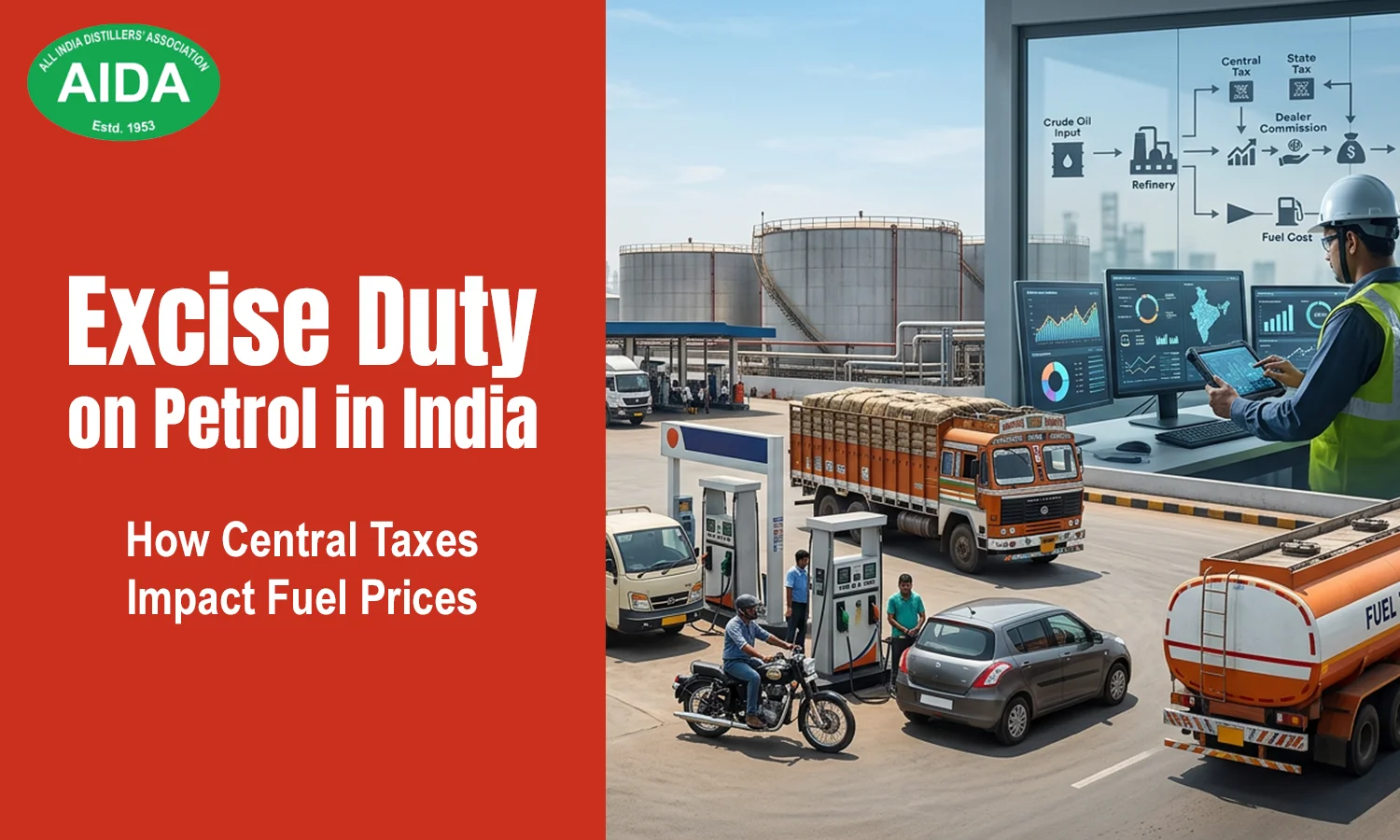
Every time you pay for fuel at a petrol pump, a large part of the amount goes toward taxes. One of the biggest components behind the rising petrol price is the excise duty on petrol charged by the central government. Many people believe fuel prices depend only on crude oil rates, but taxes also play a major role in deciding what consumers finally pay.
India imports nearly 88% of its crude oil requirements. This makes the country highly vulnerable to global conflicts, supply disruptions, and rising international oil prices. To manage these risks, the government uses the central excise duty on petrol as both a revenue tool and an economic cushion. At the same time, India is steadily reducing its dependence on imported oil through ethanol blending and domestic fuel alternatives supported by organisations like AIDA.
What Is Excise Duty on Petrol and Why Does India Levy It?
To understand what excise duty on petrol is, think of it as a tax charged by the central government when fuel leaves the refinery. This tax is added before petrol reaches retail fuel stations.
The current structure of excise duty on petrol in India includes multiple components:
| Tax Component | Amount Per Litre |
|---|---|
| Basic Excise Duty | ₹1.40 |
| Special Additional Excise Duty | ₹3.00 |
| Agriculture Infrastructure Cess | ₹2.50 |
| Road & Infrastructure Cess | ₹5.00 |
Together, these taxes form a major portion of the fuel pricing system.
The government levies excise duty on petrol and diesel for several reasons:
- To fund highways, ports, and railway projects
- To support welfare and infrastructure programs
- To create a financial buffer during global crude oil shocks
- To regulate fuel demand and support cleaner fuel adoption
Petrol remains outside the GST system because the government wants flexibility to increase or reduce taxes depending on global market conditions.
How Central Taxes Increase the Final Petrol Price.
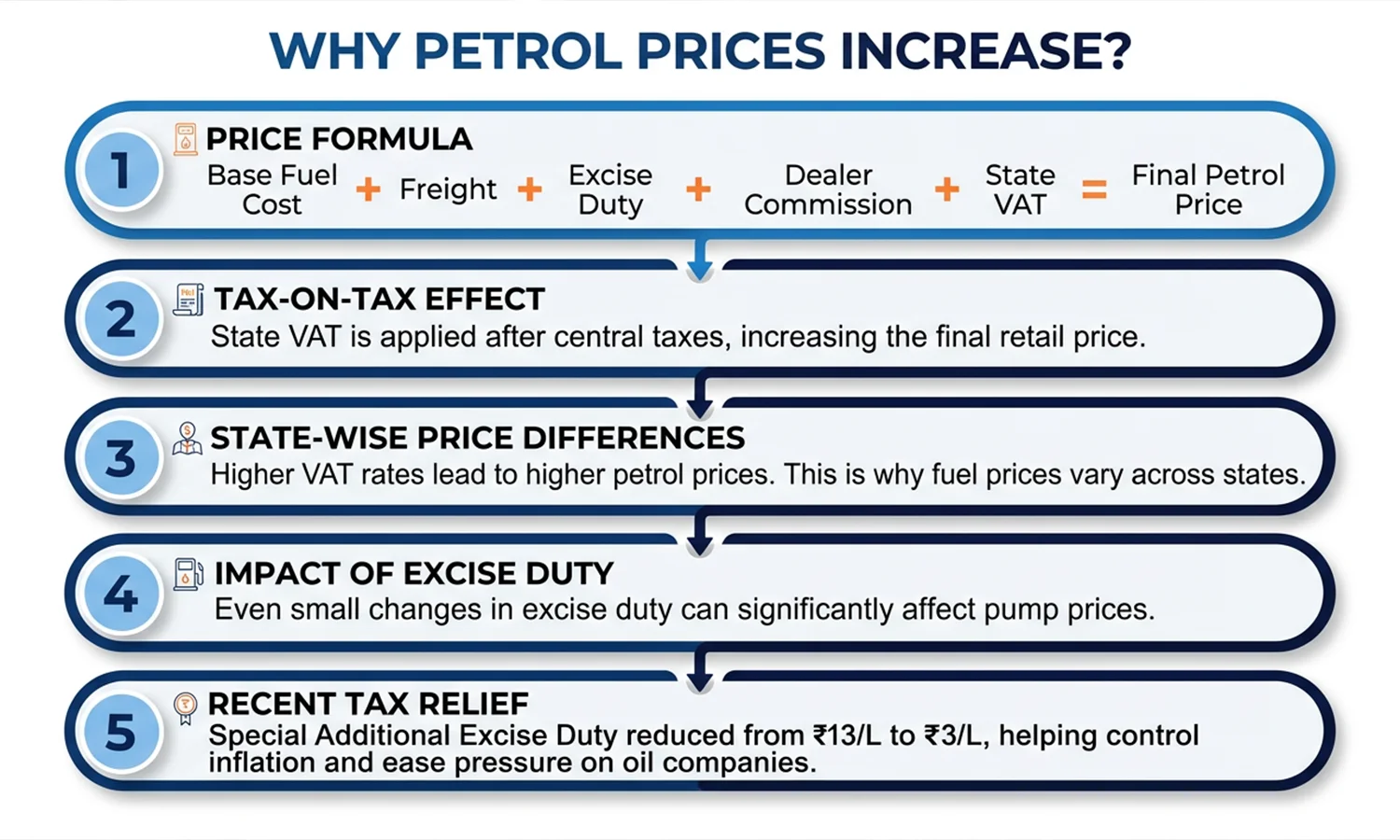
The biggest reason fuel prices rise sharply is the compounding tax structure. The central excise duty on petrol acts as the base layer before state governments apply VAT.
The pricing formula works like this:
Base Fuel Cost + Freight Charges + Excise Duty + Dealer Commission + State VAT = Final Petrol Price
This creates a “tax-on-tax” effect because state VAT is charged after adding central taxes.
That is why the same petrol costs different amounts in different states. States with higher VAT rates automatically push up the final retail price.
For example:
- Telangana applies a VAT of around 35%
- Andhra Pradesh also has high state fuel taxes.
- Delhi has comparatively lower VAT rates.
Even small changes in excise duty on petrol can significantly increase the final amount consumers pay at the pump.
During recent West Asia geopolitical tensions and crude price spikes, the government reduced the special additional excise duty from ₹13 per litre to ₹3 per litre. This helped prevent runaway inflation and protected oil marketing companies (OMCs) from heavy financial losses.
How Fuel Taxes Connect to India’s Energy Security
India’s fuel tax system is closely linked to national energy security. Since the country depends heavily on imported oil, fuel taxes are used to stabilise the economy during international disruptions.
When global crude prices suddenly rise:
- The rupee weakens against the US dollar
- Import bills increase sharply.
- Transport and logistics costs rise
- Inflation spreads across food and consumer goods
To reduce this pressure, the government uses fuel taxes strategically.
When crude oil becomes cheaper globally, the government may increase excise duty on petrol and diesel to build fiscal reserves. When crude prices surge, taxes are reduced temporarily to control inflation.
This balancing act helps protect the economy from extreme global volatility.
India has also invested fuel tax revenue into:
- Strategic crude oil reserves
- Railway electrification
- Green logistics corridors
- Ethanol blending infrastructure
- Alternative fuel programs
These investments are slowly reducing India’s dependence on imported fossil fuels.
How Ethanol Blending Is Reducing Fuel Price Pressure
One of the biggest long-term solutions to volatile fuel pricing is ethanol blending.
Under the Ethanol Blended Petrol (EBP) program, India successfully achieved nationwide E20 fuel rollout. This means 20% of every litre of petrol sold today comes from domestically produced ethanol.
This shift creates major economic advantages:
| Impact | Result |
|---|---|
| Crude Oil Replacement | 27.7 million metric tonnes displaced |
| Foreign Exchange Savings | ₹1.63 lakh crore saved |
| Domestic Fuel Stability | Lower exposure to crude price spikes |
Unlike imported oil, ethanol pricing is controlled domestically. This makes fuel costs more stable.
Another major advantage is taxation. Conventional fuel faces heavy compounding taxes, but ethanol used under the EBP program attracts only 5% GST. The government also imposes an additional ₹2 per litre penalty on unblended petrol to encourage oil companies to maximise ethanol blending.
India’s feedstock diversification has also strengthened supply security:
- Maize now contributes nearly 45% of ethanol production.
- Surplus rice and damaged grains are being utilised.
- Sugarcane and B-heavy molasses continue to support the supply
The Bureau of Indian Standards (BIS) has already notified technical standards for E22, E25, E27, and E30 fuel blends, preparing India for the next phase of fuel transition.
How AIDA Supports India’s Fuel Self-Reliance Vision
The All India Distillers’ Association (AIDA) plays a direct role in India’s energy transition.
As the apex body representing grain-based and molasses-based distilleries, AIDA helps bridge agriculture and fuel production.
AIDA’s contribution includes:
- Supporting nationwide E20 implementation
- Expanding ethanol production capacity
- Promoting multi-feedstock fuel systems
- Advocating for E30 fuel standards
- Supporting Flex-Fuel Vehicle (FFV) adoption
- Encouraging dedicated ethanol dispensing pumps
AIDA has also pushed for lower GST rates on flex-fuel vehicles to make green mobility more affordable for consumers.
By replacing imported crude oil with domestic ethanol, AIDA’s member distilleries are helping India stabilise fuel costs while strengthening long-term energy security.
Conclusion
The excise duty on petrol is much more than a simple fuel tax. It acts as a financial tool, an inflation buffer, and a strategic mechanism for national energy planning. While high fuel taxes often impact consumers directly, they also help India manage global oil shocks and fund large-scale infrastructure development.
At the same time, India’s long-term strategy is clearly shifting toward domestic alternatives like ethanol. Through higher blending targets, flexible fuel policies, and expanded production capacity, the country is gradually reducing its dependence on imported crude oil.
Organisations like AIDA continue to play a major role in building this self-reliant fuel ecosystem by supporting ethanol expansion, cleaner mobility, and future-ready energy infrastructure.
FAQs
What is excise duty on petrol?
Excise duty on petrol is a tax charged by the central government when fuel leaves the refinery. It becomes part of the fuel cost before the petrol reaches retail pumps.
Why is petrol not included under GST?
Petrol remains outside GST because the government wants flexibility to increase or reduce taxes depending on crude oil prices and economic conditions.
How does excise duty affect petrol prices?
The central excise duty on petrol increases the base fuel cost. State VAT is then applied on top of this amount, increasing the final pump price further.
How does ethanol blending reduce fuel price pressure?
Ethanol blending reduces dependence on imported crude oil. Since ethanol is produced domestically, it protects India from sudden global crude price spikes and helps stabilise fuel costs.
What role does AIDA play in India’s fuel transition?
AIDA supports ethanol expansion, promotes higher blending targets like E30, and works with policymakers to strengthen India’s domestic fuel ecosystem.