
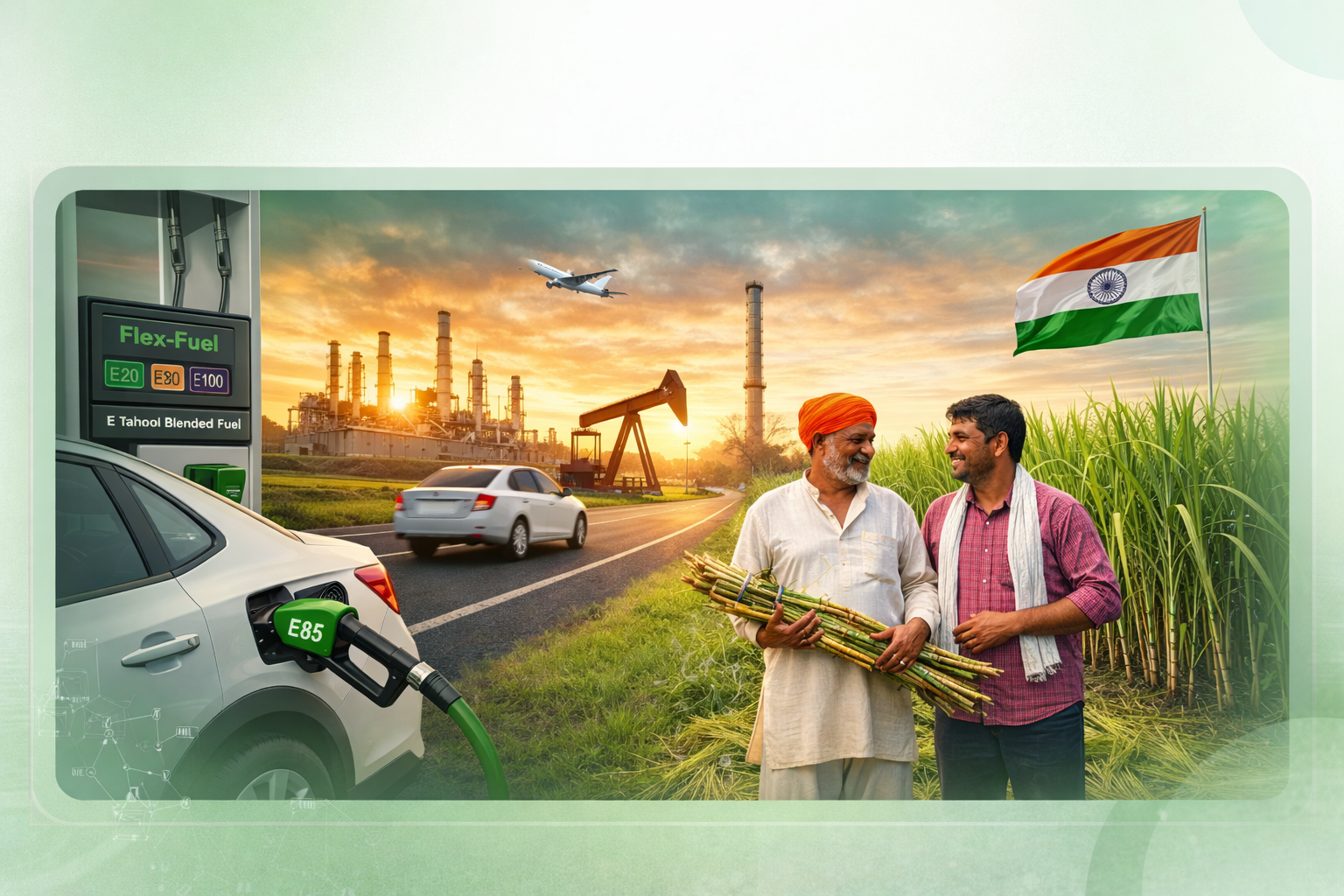
India imports roughly 85% of the crude oil it consumes. Every time prices spike in the Middle East, whether because of a pipeline dispute, a cartel meeting, or a conflict nobody saw coming, India pays the bill. That's not an energy policy. That's a vulnerability.
What if the answer, or at least a big part of it, was already sitting in our farms and distilleries? That's the case for flex-fuel vehicles, and it's a stronger argument than most people realise.
Why mobility is the heart of India's oil problem
Transportation isn't just one sector among many when it comes to oil consumption. It accounts for around 70% of India's refined petroleum use. Everything else, industry, power, aviation, splits the remaining 30%. So if you want to reduce how much crude India burns through every year, the place to start is on the road.
And it's not just about the money. When global crude prices shoot up, the rupee weakens, import bills balloon, and the government faces pressure on fuel subsidies. The ripple effects hit inflation, fiscal deficits, and ordinary household budgets. This isn't abstract macroeconomics. It's the reason petrol prices at your local pump feel connected to events happening thousands of kilometres away.
Any serious attempt to fix this has to balance three things at once: keeping fuel affordable, reducing environmental damage, and building resilience against external shocks. Electric vehicles speak to the first two over the long run. Flex-fuel vehicles can speak to all three right now.
So what exactly is a flex-fuel vehicle?
A flex-fuel vehicle (FFV), in simple terms, is a car or two-wheeler that can run on petrol, ethanol, or any blend of the two. It can operate on fuels ranging from standard petrol available at pumps to higher ethanol blends like E85 (85% ethanol) and even pure ethanol (E100), depending on the vehicle’s design and compatibility.
The engine is modified to handle different fuel compositions, slightly different fuel injectors, a corrosion-resistant fuel system, and sensors that detect the blend and adjust combustion accordingly. That's largely it. It's not a radical reinvention. It's an upgrade.
What matters is what this means for the person driving it. You fill up at a regular petrol station. There's no long charging wait. No anxiety about whether there's an outlet at your destination. You can use whatever blend is available and the car figures the rest out. From a consumer perspective, the friction of switching is genuinely low.
The blends work like this. E20 is 20% ethanol, already being rolled out across India's new vehicle fleet. E85 is where things get more interesting. It's what Brazil runs on and what India's next phase is targeting. E100 is pure ethanol, which India has actually begun making available at over 15,000 outlets nationwide.
Why this makes particular sense for India
India isn't just any country when it comes to ethanol. It has one of the world's largest sugarcane industries, a rapidly growing maize sector, and a network of distilleries that have been scaling up aggressively over the past decade. The raw material for ethanol isn't something India needs to import. It grows here, in enormous quantities, and it employs millions of farmers.
That changes the strategic picture entirely. When India burns ethanol in its vehicles instead of petrol, it's replacing an import with a domestic product. The money that would have gone to oil-exporting nations stays in India, and a significant chunk of it goes directly to farmers.
The environmental side matters too. Ethanol from agriculture feedstock reduces lifecycle greenhouse gas emissions by somewhere between 40 and 60% compared to petrol. That's not a rounding error. It's a meaningful contribution toward India's climate commitments, achievable
What the numbers actually show:
- Rs 1,70, 560 crore in foreign exchange saved since 2014 through ethanol blending
- 869 lakh metric tonnes of CO2 emissions reduced since the programme began
- Ethanol blend in petrol grew from 1.5% in 2013-14 to 20% by 2025.
- Rs 1,50, 925 crore paid to farmers as ethanol feedstock suppliers since the programme expanded
India's progress so far, and where the gap is
A decade ago, the share of ethanol blended into India's petrol supply was barely 1.5%. Today it sits around 20 %, with a target to scale beyond the near future. That doesn't sound dramatic until you do the arithmetic. At scale, each additional percentage point of blending substitutes for a meaningful volume of crude oil imports.
India’s ethanol blending programme has delivered significant economic and environmental gains over the past decade. According to official government data, ethanol blending since 2014 has resulted in foreign exchange savings of over ₹1.06 lakh crore, reduced carbon dioxide emissions by around 544 lakh metric tonnes, and displaced approximately 181 lakh metric tonnes of crude oil imports. The programme has also strengthened rural incomes, with cumulative payments to farmers and distillers amounting to tens of thousands of crores. In the 2022 to 2023 ethanol supply year, oil marketing companies reported substantial cost savings, while farmers benefited from increased demand for feedstock such as sugarcane and grain. Meanwhile, India’s ethanol production capacity has expanded rapidly, more than doubling in recent years to over 1,600 crore litres by 2024, with further expansion underway to meet higher blending targets.
But here's the gap. India has made impressive progress on blending fuel, but hasn't yet made the leap to a genuine flex-fuel vehicle ecosystem. Most new cars are E20-compatible, fine for a 20% blend, but vehicles capable of running on E85 or E100 are still rare. The distribution network for higher-blend fuels outside major cities is thin.
The first chapter of India's ethanol story has been a remarkable success. The second chapter is still being written.
What actually makes flex-fuel adoption work
Looking at countries that have done this well, and those that haven't, a clear pattern emerges. Success comes down to three things working together. When any one of them is missing, the whole thing stalls.
Policy that actually commits. Blending mandates, differential pricing for ethanol, manufacturing incentives, and consistent regulatory signals across political cycles. India's CAFE norms are already being aligned to encourage FFV production. Brazil's Proalcool programme, running continuously since 1975, is the clearest example of what sustained commitment looks like.
Fuel that's actually available. A flex-fuel vehicle that can't find higher-blend fuel within a reasonable distance is just a regular car. Distribution infrastructure, storage upgrades at petrol stations, supply chain logistics, and strategic reserves have to keep pace with vehicle adoption. India's 15,600+ E100 outlets are a start, but rural coverage remains the weak link.
Consumers who choose it. Where ethanol has been price-competitive and widely available, people have switched. Where it hasn't, subsidies alone rarely move the needle. Trust builds slowly. Drivers need to know that running on E85 won't damage their engine, won't leave them stranded, and won't cost more per kilometre than petrol.
These three don't work in isolation. Weak infrastructure undermines consumer confidence. Poor policy signals deter infrastructure investment. Low consumer uptake makes the economics of distribution harder. You have to move all three together.
What about electric vehicles?
It's worth being direct here, because the EV versus FFV framing is a false choice that keeps coming up. They're not competing. They serve different purposes across different timeframes.
EVs offer zero tailpipe emissions, but the charging infrastructure is still overwhelmingly urban and dependent on fossil fuel. Battery minerals are largely imported. The upfront cost is high. Fleet penetration sat at just 7.44% in 2024, concentrated almost entirely in two-wheelers and three-wheelers. India's own lithium deposits, discovered in Jammu and Kashmir in 2023, are still nearly a decade from commercial extraction.
FFVs, by contrast, work with the existing petrol station network, carry no significant cost premium over standard petrol cars, and are accessible today across urban and rural India. They deliver lower-but-real emissions reductions, right now, without waiting for a charging network that rural India may not see for another decade.
India's EV charging network currently operates at around 5% utilisation, well below the 10 to 12% needed for stations to break even commercially. That makes private investment in rural charging a hard sell. None of that means EVs are the wrong long-term bet. It means they can't carry the full weight of India's energy security ambitions today. Flex-fuel vehicles and EVs, both the technologies can grow in parallel rather than one waiting for the other.
The challenges, and they're real
Any honest case for flex-fuel adoption has to acknowledge the friction points. There are four worth taking seriously.
Food versus fuel. When distilleries compete with food consumers for maize, rice or sugarcane, food prices can rise. Feedstock policy needs to prioritise agricultural residues and surplus crops, not staples that food markets depend on.
Water intensity. Sugarcane is a thirsty crop. Scaling up sugarcane-based ethanol production in water-stressed regions without proper water management frameworks risks trading one vulnerability for another.
FFV cost premium. Flex-fuel vehicles carry a modest cost premium over equivalent standard petrol cars, mainly because the modified fuel system adds to manufacturing costs. This gap narrows as production volumes grow, and government incentives can bridge it during the transition. But it's a barrier for price-sensitive buyers right now.
Supply variability. Ethanol production depends on agriculture, which means it depends on weather. Brazil had a sharp reminder of this in 2024-25 when a difficult harvest season disrupted supply. India will need strategic ethanol reserves and genuine feedstock diversification to offer the reliability consumers expect from fuel.
These aren't reasons to abandon the approach. They're the practical limits that any serious policy programme has to design around. Acknowledging them honestly is how you build something durable.
India's all-fuels approach is the right call
India has sensibly refused to pick one technology and bet everything on it. The national mobility strategy covers EVs, FFVs, compressed natural gas, and hydrogen. Each is suited to different segments, different geographies, and different budget levels.
This isn't indecision. It's a rational response to the enormous diversity of India's infrastructure conditions. A buyer in Bengaluru is in a completely different situation from a farmer in rural Uttar Pradesh who needs a reliable vehicle and has no charging point within 50 kilometres.
Flex-fuel vehicles have a specific and irreplaceable role in this mix. They deliver immediate emission reductions and import savings using infrastructure that already exists, while longer transitions build momentum. That's not a consolation prize. It's exactly the kind of near-term leverage that's hardest to find in energy policy.
What Brazil's experience actually tells us
The short version: it works, but it takes time and consistency. Brazil launched its national alcohol programme, Proalcool, in 1975. Today, roughly 83% of new light vehicle registrations are flex-fuel. That transformation happened over four decades of uninterrupted policy commitment, domestically competitive ethanol prices, and near-universal fuel availability at petrol stations.
The lesson isn't that India needs to copy Brazil. It's that the outcome Brazil achieved, near-complete market transformation, is genuinely achievable. What it requires is consistency. Brazil didn't get there because of one government or one minister. It got there because the policy survived elections, economic crises, and oil price collapses. That's the standard India needs to hold itself to as the programme enters its next phase.
The Road ahead
India has built something real in the past decade. The ethanol blending numbers are genuine achievements, the farmer payments are concrete economic transfers, and the foreign exchange savings are measurable. That foundation exists and it's solid.
What comes next is harder in some ways, because it requires moving from a supply-side programme, more ethanol in the fuel mix, to a demand-side transformation: more vehicles that can actually use it. That means more FFV models at accessible price points, better distribution of higher-blend fuels outside major cities, and sustained consumer communication about why any of this matters.
The automotive industry is already responding. Major manufacturers are developing FFV prototypes and pilot programmes. Oil marketing companies are expanding ethanol supply chains. The regulatory environment is aligning, slowly but clearly, in the right direction. The question is whether the policy commitment that drove the first phase can carry through into the second. That's always the harder part.
India imports 85% of its crude oil. Every year that fraction stays high is another year of exposure to every geopolitical event in every oil-producing region on earth. Flex-fuel vehicles won't fix that overnight, and they won't fix it alone. But they can start fixing it today, using infrastructure that already exists, with domestic resources that are already being produced.
The transition is already underway. The question is whether India accelerates it, or lets the momentum stall while waiting for a future that's still being built.