
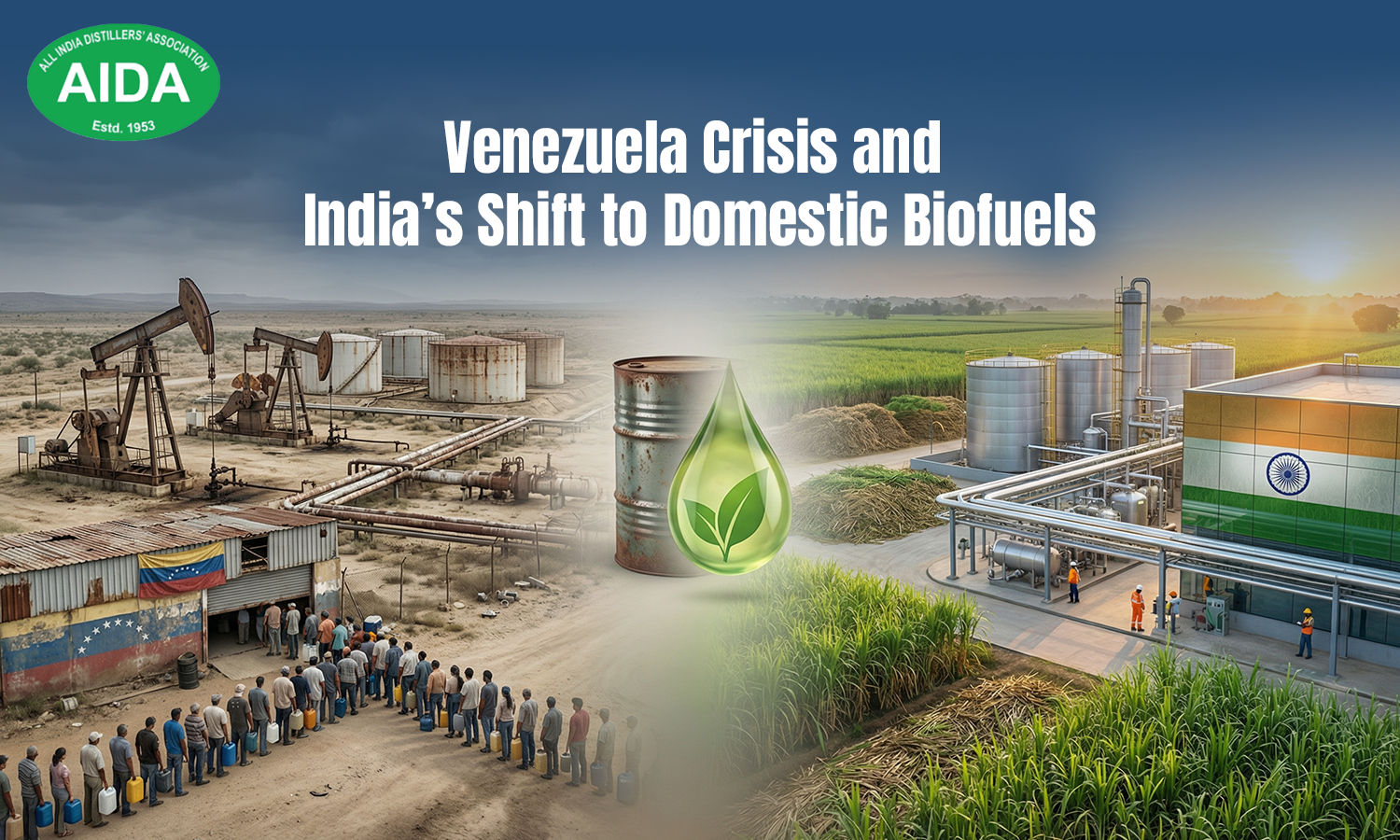
The ongoing crisis in Venezuela, a country with vast oil reserves yet constrained by economic and geopolitical challenges, once again exposes the vulnerability of global energy supply chains. When disruptions affect oil-producing nations, the impact extends far beyond borders, influencing fuel availability, pricing, and economic stability worldwide. For countries that rely heavily on imported fossil fuels, such events underline a fundamental risk of external dependence.
For India, this moment reinforces the importance of strengthening energy security through reliable and domestically anchored alternatives. Rather than reacting to global volatility, India has steadily built capacity around domestic biofuel production, demonstrating that locally produced fuels can play a meaningful role in meeting national energy needs while reducing exposure to international disruptions.
Ethanol Blending as a Stabilising Force
India’s progress in ethanol blending has emerged as a clear stabilising factor within its energy strategy. The country achieved its 20 percent ethanol blending target (E20) well ahead of the original 2030 timeline. Ethanol-blended petrol is now an established part of the national fuel mix, helping reduce reliance on imported crude oil and insulating the economy from global oil price fluctuations.
Members of the All India Distillers' Association (AIDA) currently contribute close to 20 per cent of India’s fuel requirements through ethanol blending. This contribution has delivered tangible economic benefits, including foreign exchange savings estimated at over ₹1.4 lakh crore, while strengthening India’s resilience against fuel import disruptions.
Beyond Petrol: Expanding the Biofuel Pathway
While ethanol has proven effective in reducing petrol imports, diesel continues to dominate India’s transport, logistics, and freight sectors. Addressing diesel dependence, therefore, remains an important priority within the broader fuel transition.
In this context, isobutanol is being evaluated as a credible advanced biofuel option. When blended with diesel, isobutanol offers higher energy density and improved compatibility compared to conventional ethanol, making it suitable for existing diesel engines. Ongoing assessments and pilot initiatives are examining its potential to complement current fuel systems and gradually reduce diesel imports.
This reflects a measured expansion of India’s sustainable biofuels roadmap, focused on diversification and compatibility rather than disruption.
A Farmer-Centric Energy Model
A defining strength of India’s biofuel strategy lies in its close integration with agriculture. By creating sustained and assured demand for agricultural feedstocks, biofuel production directly supports rural livelihoods while contributing to national energy goals.
Crops such as maize, rice, and sugarcane are increasingly recognised as strategic resources within a farmer-centric energy model. The shift towards grain-based ethanol has enabled year-round production and better utilisation of surplus agricultural output. Cumulatively, ethanol procurement has channelled over ₹1.2 lakh crore to farmers, reinforcing income stability and strengthening rural economic resilience.
This linkage ensures that the benefits of domestic biofuel production extend beyond fuel substitution to broader socio-economic development.
Aligning Energy Security with Climate Commitments
India’s focus on biofuels also supports its long-term climate objectives. Expanding ethanol and advanced biofuel usage contributes to lower lifecycle emissions compared to conventional fossil fuels, while supporting cleaner mobility solutions.
Encouraging local fuel production across multiple feedstocks strengthens India’s ability to move steadily toward its Net Zero 2070 commitment. Biofuels offer an immediately deployable solution that bridges current energy needs with long-term sustainability goals, without waiting solely on future technologies.
Conclusion: AIDA’s Role in India’s Energy Transition
The situation in Venezuela highlights a broader reality for energy-importing nations: sustained dependence on external fuel sources carries inherent economic and strategic risks. India’s experience with ethanol blending demonstrates that these risks can be addressed through consistent policy support and scalable domestic solutions.
As the apex national body representing ethanol producers, the All India Distillers’ Association (AIDA) plays a central role in strengthening India’s energy security by supporting domestic biofuel production, encouraging diversified feedstocks, and enabling a farmer-linked fuel ecosystem. By continuing to promote ethanol, evaluating advanced fuels such as isobutanol, and reinforcing assured demand for crops such as maize, rice, and sugarcane, AIDA contributes meaningfully to India’s transition toward a more self-reliant, resilient, and sustainable energy future.