
.webp)
Overview
Every time fuel prices rise, one question inevitably follows: Why is petrol so expensive?
For years, the answer has largely revolved around taxes, crude oil imports and government policy. While those factors continue to influence fuel pricing, a new variable is beginning to reshape India's fuel economy: ethanol.
Today, ethanol is no longer just an industrial alcohol or a blending component. It has become a strategic resource that connects India's energy security, agricultural economy, environmental goals and transportation sector. Through the country's expanding ethanol blending programme, domestically produced ethanol is helping reduce crude oil dependence while creating new opportunities for farmers, distilleries and rural industries.
As the apex national body representing India's distillery sector since 1953, AIDA (All India Distillers' Association) has witnessed this transformation firsthand. From supporting production expansion to advocating higher blending targets, AIDA continues to play an important role in India's evolving biofuel ecosystem.
Why is Petrol Costlier Than Diesel?
One of the most common misconceptions is that petrol is more expensive because it costs significantly more to refine.
In reality, refinery-level production costs for petrol and diesel are relatively similar. In some cases, diesel production can even be more expensive due to stringent treatment requirements and fuel quality standards.
The primary reason petrol is costlier than diesel lies in taxation and economic policy.
Fuel prices in India are determined through multiple layers:
- Base fuel cost
- Freight charges
- Central excise duty
- Dealer commission
- State VAT
- Additional state levies
Petrol generally attracts higher taxation than diesel across most states.
This distinction exists because diesel powers critical sectors of the economy, including:
- Freight transportation
- Agriculture
- Public transport
- Industrial logistics
- Rail movement
A significant increase in diesel prices can quickly raise the cost of food, medicines and essential goods across the country. To avoid inflationary pressure, governments often maintain a more favourable tax structure for diesel.
India's Dependence on Imported Crude Oil
Fuel pricing in India is closely linked to global energy markets.
The country imports the majority of its crude oil requirements, making domestic fuel prices sensitive to:
- Global crude oil prices
- Geopolitical developments
- Shipping disruptions
- Currency fluctuations
- Rupee-Dollar exchange rates
When international oil prices rise or the rupee weakens, fuel import costs increase.
This dependence on imported energy creates economic vulnerabilities that extend beyond fuel stations. Rising crude oil prices affect transportation, manufacturing, logistics and overall inflation.
Reducing this dependence has therefore become a major national priority.
This is where ethanol enters the conversation.
How Ethanol is Changing India's Fuel Economy
The most visible use of ethanol today is in transportation fuel.
Under India's Ethanol Blended Petrol Programme, ethanol is mixed with petrol before being distributed to consumers. The blend percentage is represented using the letter "E".
For example:
- E10 contains 10% ethanol
- E20 contains 20% ethanol
India achieved approximately 20% ethanol blending during Ethanol Supply Year 2024–25, reaching the milestone ahead of the original target timeline.
This achievement represents one of the fastest large-scale biofuel transitions in the world.
Every litre of ethanol blended into petrol reduces the amount of imported fossil fuel required by the country. Over time, this helps lower exposure to volatile international oil markets while improving energy security.
The impact extends beyond fuel stations. Increased ethanol production creates demand for agricultural feedstocks, supports rural economies and strengthens domestic manufacturing capacity.
The Many Uses of Ethanol Beyond Fuel
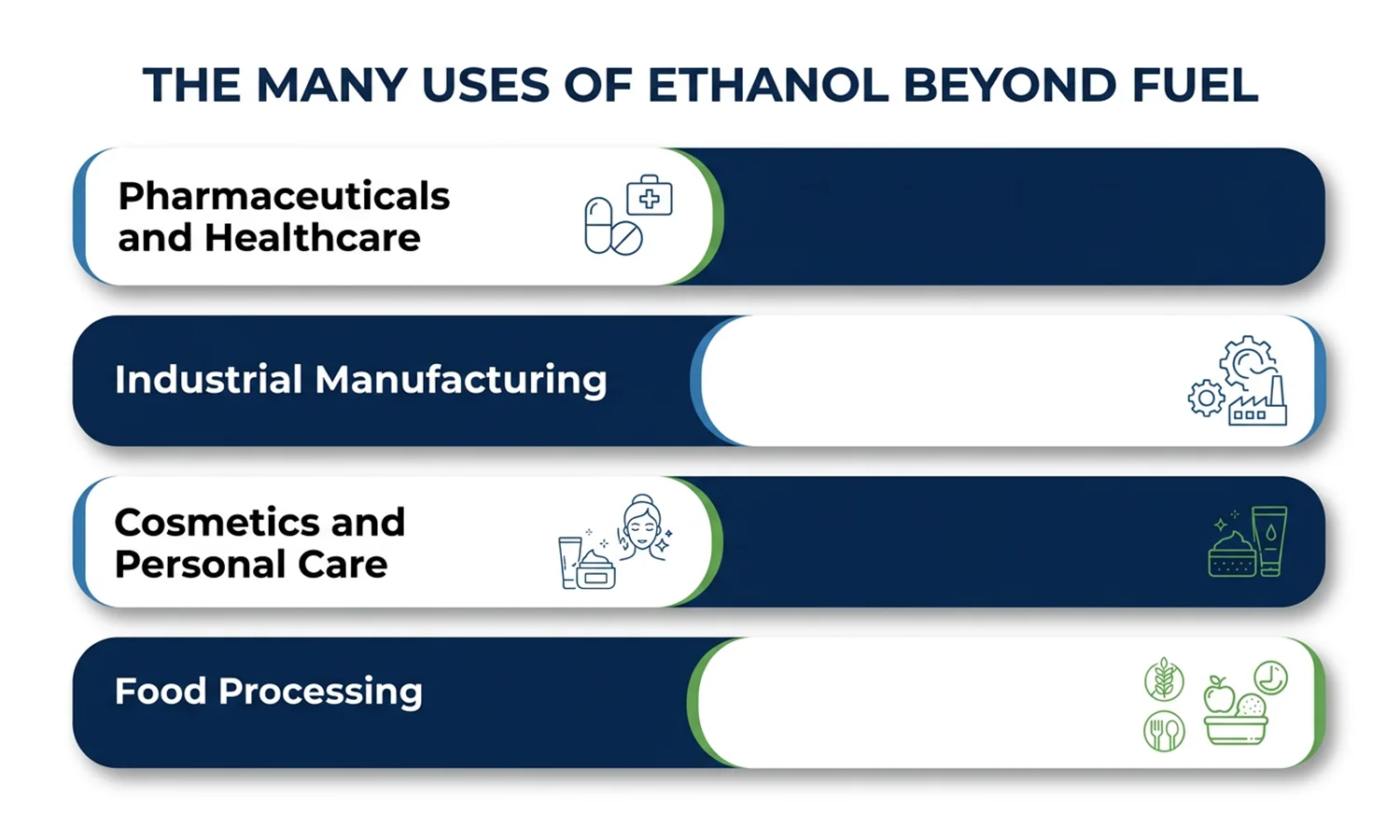
While fuel blending receives the most attention, the uses of ethanol extend far beyond transportation.
Today, ethanol supports several important sectors across the economy.
Pharmaceuticals and Healthcare
Ethanol is widely used in:
- Medical disinfectants
- Hand sanitisers
- Syrups
- Pharmaceutical formulations
- Antiseptic products
Its effectiveness as a solvent and disinfectant makes it indispensable in healthcare applications.
Industrial Manufacturing
Industrial uses of ethanol include:
- Paints
- Coatings
- Varnishes
- Chemical processing
- Industrial solvents
Many manufacturing sectors rely on ethanol as both a processing aid and a raw material.
Cosmetics and Personal Care
High-purity ethanol is commonly used in:
- Perfumes
- Fragrances
- Skincare products
- Haircare formulations
Its ability to evaporate cleanly and stabilise ingredients makes it valuable across the personal care industry.
Food Processing
Ethanol is also used for flavour extraction, preservation and specialised food manufacturing applications.
These diverse applications demonstrate why ethanol has become one of the most versatile products produced by India's distillery sector.
Ethanol's Impact on Farmers and Rural India
One of the most significant outcomes of ethanol expansion has been its impact on agriculture.
Traditionally, sugarcane served as the primary feedstock for ethanol production. Today, the industry operates through a diversified feedstock model that includes:
- Sugarcane juice
- B-heavy molasses
- C-heavy molasses
- Maize
- Broken rice
- Surplus grains
This diversification has created new opportunities for farmers and strengthened rural value chains.
Instead of relying solely on traditional commodity markets, agricultural producers now participate directly in India's energy economy.
Distillery investments have also encouraged local industrial development, job creation and infrastructure growth across several states.
As ethanol production capacity expands, rural communities continue to benefit from the industry's growth.
AIDA's Role in India's Ethanol Transition
The growth of India's ethanol ecosystem has required close collaboration between producers, policymakers and industry stakeholders.
Representing members that account for more than 80% of India's distillation capacity, AIDA has consistently supported initiatives aimed at strengthening ethanol production and adoption.
Over the years, AIDA has advocated for:
- Higher ethanol blending targets
- Feedstock diversification
- Distillery capacity expansion
- Flex-fuel vehicle readiness
- Long-term biofuel development
- Sustainable ethanol growth
The association has also contributed to discussions surrounding future blending pathways and the next phase of ethanol adoption in India.
As the industry evolves, AIDA continues to serve as an important voice representing the interests of India's distillery sector.
What Comes After E20?
Achieving E20 was a major milestone, but India's ethanol journey is far from complete.
Industry discussions are increasingly focused on:
- E22 fuel
- E25 fuel
- E30 fuel
- Flex-fuel vehicles
- Sustainable Aviation Fuel (SAF)
- Second-generation (2G) ethanol
Recent developments in vehicle certification and flex-fuel technologies suggest that ethanol's role in transportation could continue to expand significantly over the coming years.
These developments create opportunities to further strengthen energy security while supporting domestic production and innovation.
Conclusion
Understanding why petrol is costlier than diesel provides valuable insight into how India's fuel economy operates. However, the bigger story today is how ethanol is gradually changing that system.
Through ethanol blending, India is reducing crude oil dependence, supporting farmers, strengthening domestic industry and building a more resilient energy ecosystem.
What began as a fuel-blending initiative has evolved into a broader economic and energy strategy with benefits extending across transportation, agriculture, manufacturing and sustainability.
As India moves towards higher blending targets and future biofuel technologies, organisations like AIDA will continue to play an important role in supporting the growth of a stronger and more self-reliant ethanol ecosystem.
Key Takeaways
- Petrol is costlier than diesel primarily because of taxation and economic policy.
- India remains heavily dependent on imported crude oil.
- Ethanol blending helps reduce fossil fuel dependence and strengthen energy security.
- The uses of ethanol extend beyond fuel into healthcare, manufacturing, cosmetics and food processing.
- Ethanol expansion supports farmers and rural economies through diversified feedstock demand.
- India achieved approximately 20% ethanol blending during Ethanol Supply Year 2024–25.
- AIDA continues to support the growth and development of India's ethanol ecosystem.
Frequently Asked Questions
Why is petrol more expensive than diesel in India?
Petrol generally carries higher taxes than diesel. Governments maintain lower diesel taxation because diesel powers transportation, logistics and agriculture, all of which influence inflation.
How does ethanol help reduce fuel dependence?
Ethanol replaces a portion of imported petrol with domestically produced renewable fuel, helping reduce crude oil imports and strengthen energy security.
What are the major uses of ethanol?
Major uses include fuel blending, pharmaceuticals, disinfectants, cosmetics, food processing and industrial manufacturing.
How does ethanol benefit farmers?
Ethanol production creates demand for sugarcane, maize, grains and other agricultural feedstocks, generating additional income opportunities for farmers.
What role does AIDA play in India's ethanol sector?
AIDA represents India's distillery sector and supports ethanol production, policy engagement, feedstock diversification and long-term biofuel development initiatives.
About AIDA
The All India Distillers' Association (AIDA) is the apex national body representing India's distillery sector. Established in 1953, AIDA represents members accounting for more than 80% of India's distillation capacity and actively supports the growth of ethanol, bioenergy and sustainable fuel initiatives in India through industry representation, policy engagement and knowledge leadership.