
By early 2026, India hit a landmark achievement: 20percentage ethanol blending E20 became the nationwide standard. But at the All-India Distillers Association AIDA, we view E20 as the starting line, not the finish. The question is no longer about mixing fuel; it is about a systematic substitution strategy where ethanol moves from an additive to the primary energy carrier for Indian transport.
1. Beyond the Blending Wall: The Roadmap to E27 and E85
The global shift is moving toward High-Octane Substitution. While most current vehicles handle E20 seamlessly, the future relies on a phased takeover:
♦ The Immediate Jump E20 to E27: With a current national capacity of 2,000 crore litres, India has an immediate surplus. AIDA is actively pushing for a jump to E27 and E30 blending targets by 2030 to absorb this production.
♦ The Flex-Fuel Future: To replace petrol significantly, we are moving toward E85 85percentage ethanol. Manufacturers like Maruti Suzuki are already preparing the Fronx FFV for a 2026 launch, specifically designed to treat petrol as the secondary fuel.
2. The Chemistry of Performance: Why Ethanol is the Superior Fuel
Replacing petrol is not just an environmental choice; its a performance upgrade.
♦ The Octane Advantage: Standard petrol typically has an octane rating of 91. Pure ethanol boasts a rating of 108.5. This higher octane allows for higher engine compression, reducing knocking and improving acceleration.
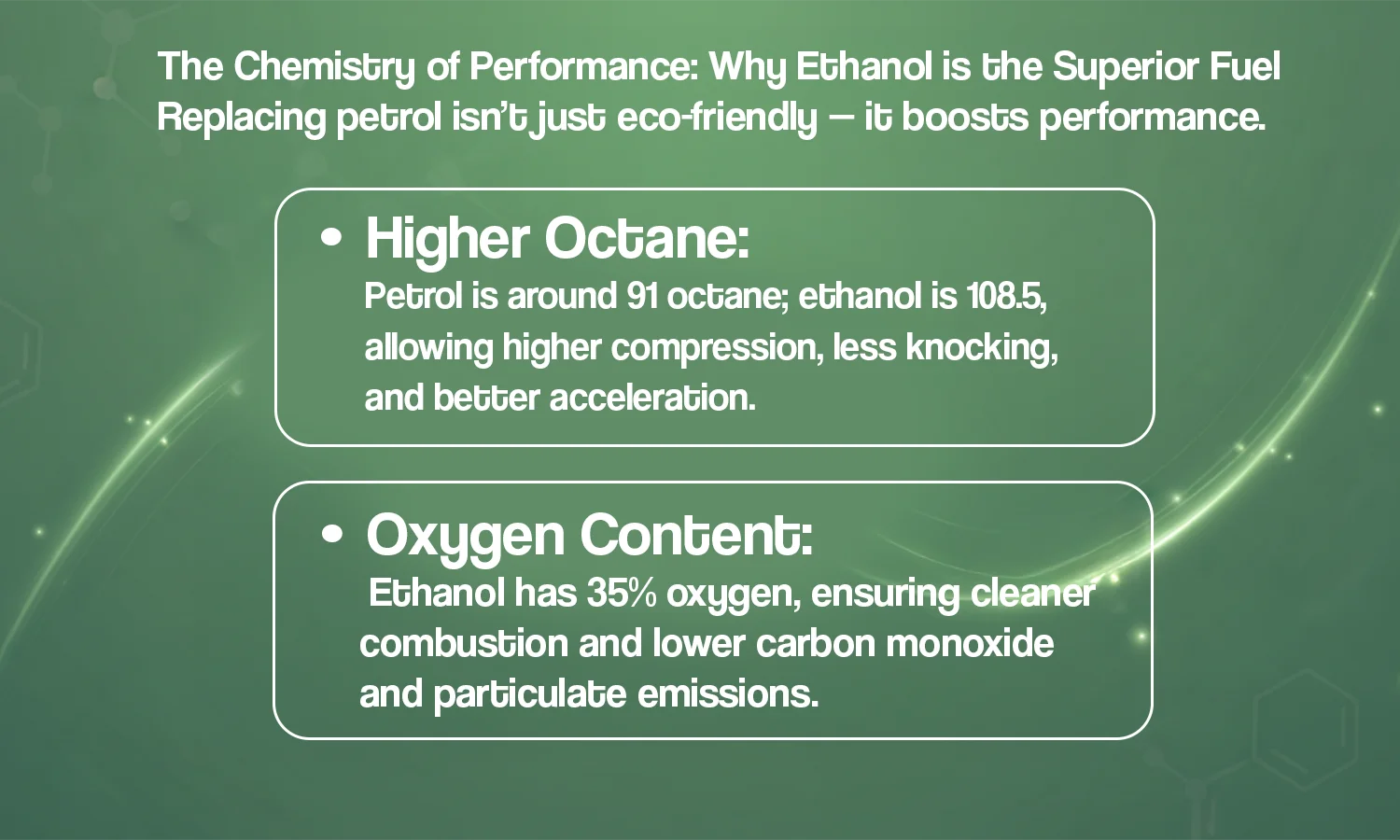
♦ 35percentage Oxygen Content: Unlike pure petrol, ethanol contains inherent oxygen. This leads to more complete combustion, drastically cutting tailpipe emissions of carbon monoxide and particulate matter.
3. Energy Sovereignty: Cutting the $137 Billion Cord
Indias dependence on imported crude, currently between 88percentage and 91percentage, is a strategic vulnerability. In FY2025 alone, the oil import bill hit roughly USD 137 billion approx. ₹11.5 lakh crore.
♦ Foreign Exchange Shield: Since 2014, the Ethanol Blended Petrol EBP program has already saved India over ₹1.36 lakh crore.
♦ Economic Stability: By producing our fuel domestically, we insulate the Indian consumer from global flashpoints and geopolitical shocks that cause petrol prices to spike overnight.
4. Feedstock Revolution: Protecting Food Security
A common concern is whether fuel will compete with the food plate. At AIDA, we are leading the transition to Second-Generation 2G Ethanol:
♦ From Grains to Waste: We are shifting production from food-grade crops to maize, broken rice, and agricultural residues like rice husks and corn cobs.
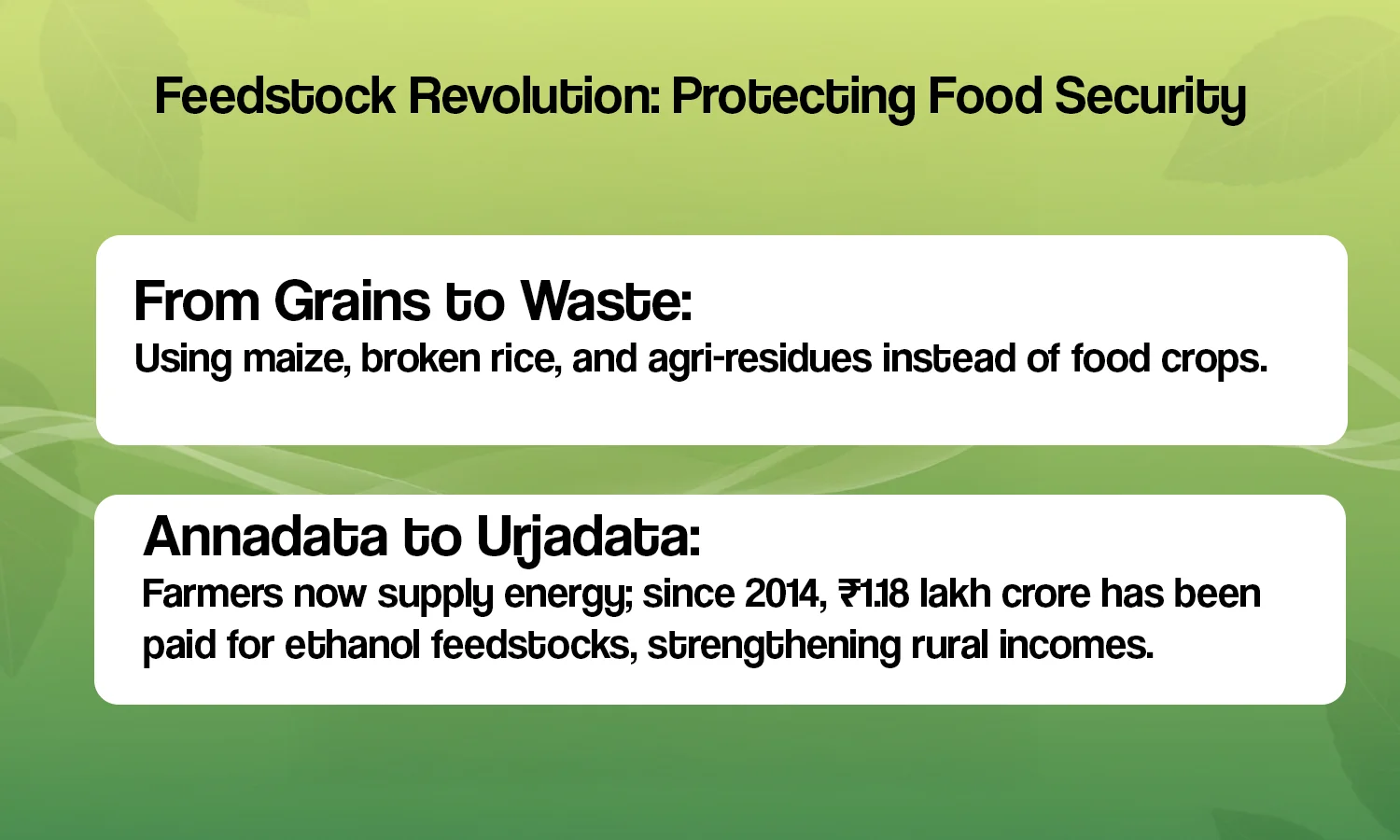
♦ Annadata to Urjadata: This shift transforms the Indian farmer from a food provider into an energy provider. Since 2014, over ₹1.18 lakh crore has been disbursed directly to farmers for ethanol feedstocks, revitalising the rural economy.
5. The Diesel Frontier: The 40percentage Challenge
Petrol replacement is only the beginning. Diesel accounts for 40percentage of India's total fuel consumption. AIDA President Vijendra Singh recently highlighted the next major breakthrough: Isobutanol and Ethanol-Diesel ED95 blending. By exploring pathways to blend ethanol into the diesel pool, we can tackle the heaviest part of India's import bill and move closer to a truly Net Zero transport sector.
FAQ
Why is ethanol considered important for Indias fuel future
It is the most scalable way to achieve Energy Sovereignty. It allows us to use our agricultural surplus to replace expensive, imported fossil fuels while providing a cleaner burn for our cities.
Do current petrol vehicles support ethanol-based fuels?
All vehicles made after April 1, 2023, are E20-compliant. For higher blends like E85, the industry is rolling out Flex-Fuel Vehicles FFVs with modified fuel lines and sensors to handle ethanol’s unique chemical properties.
Does ethanol affect mileage
Ethanol has roughly 33percentage lower energy density than petrol, which can result in a minor mileage drop 1-6percentage depending on the blend. However, the high-octane performance and lower pump price often provide a better overall value-per-kilometer for the consumer.