
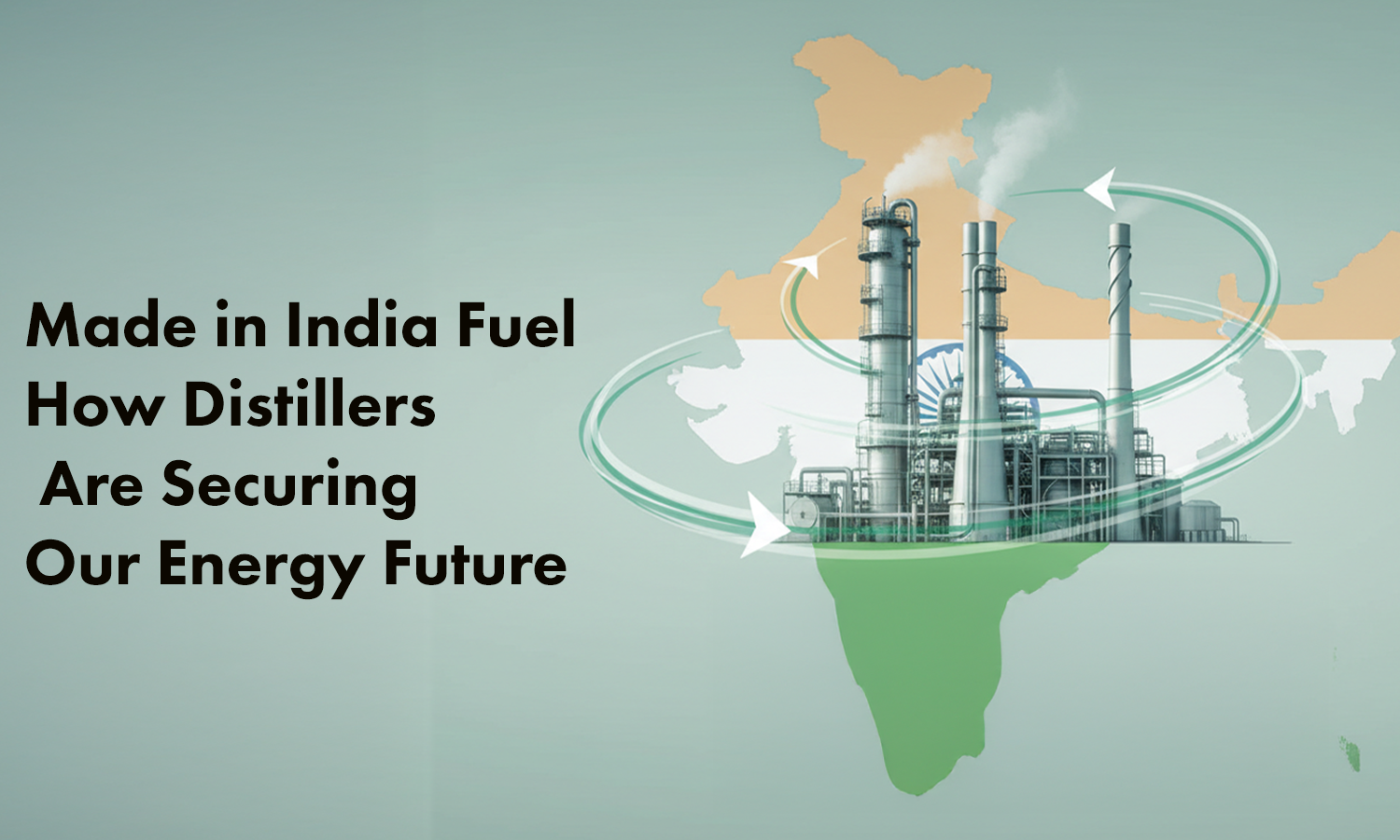
As global energy leaders gather in Goa for India Energy Week 2026, one reality is hard to ignore. Energy security in India today is no longer only about supply. It is about control, stability, and resilience.
For decades, India’s energy transition /fuel story was tied to what happened far beyond its borders. Wars, shipping disruptions, and price swings decided how much Indians paid at the pump. In 2026, that dependence is finally changing. Ethanol has become one of India’s strongest answers to global uncertainty.
At the All India Distillers’ Association, the focus is clear. Build fuel at home, use what India grows, and keep energy decisions within the country.
Breaking Free from Global Oil Shocks
India still imports more than 85 per cent of its crude oil. That dependence makes the economy vulnerable to events it cannot control.
Ethanol has started to change that equation, proving to be one of the best alternative fuels in india By early 2026, India’s ethanol blending programme will have already replaced more than 270 lakh metric tonnes of crude oil. That is not a projection. It is fuel that does not need to be shipped across oceans or paid for in dollars.
This matters for two reasons. First, it protects the country from sudden price spikes driven by global tensions. Second, it keeps money circulating within India instead of flowing out as import payments. Ethanol has quietly become a buffer between global instability and Indian consumers. One of its impactful byproducts is the E20 Ethanol Fuel, one of the best second-generation ethanol fuels in India.
The Power of Diverse Crops
Energy security works best when it does not depend on a single source. India’s ethanol programme has matured because it does not rely on one crop or one region.
What began as a sugar-based model has now evolved. In 2026, distilleries use maize, broken rice, and sugarcane, depending on availability and season, to improve ethanol production in India. This flexibility ensures fuel production continues even when one crop underperforms.
Maize has emerged as a major pillar. It now contributes over 45 per cent of India’s ethanol allocation, offering year-round stability and wider geographic coverage. This diversity makes the ethanol supply chain far more resilient than before and far less exposed to climate or regional risks.
From “Food vs Fuel” to “Food & Fuel”
For years, ethanol faced one recurring question. Does fuel production compete with food?
India’s experience has answered that clearly. Ethanol production today is built around surplus and damaged grains, not food meant for the plate. Grain that cannot be used for human consumption is converted into fuel instead of going to waste.
There is another side that often gets missed. Every litre of ethanol produced from grain also generates DDGS, a high-protein animal feed. This supports the dairy and poultry sectors and reduces dependence on imported feed ingredients. In practice, ethanol has strengthened both food systems and fuel systems.
Turning Waste into Energy
True energy security comes from using what was once discarded. This is where second-generation ethanol steps in.
Crop residues like rice straw, which were earlier burned in fields, are now becoming a fuel source. This shift addresses two problems at once. It reduces air pollution from stubble burning and creates an additional income stream for farmers.
For India, this is not just an environmental solution. It is a practical way to expand fuel supply without touching food crops.
A Supply Chain That Runs All Year
Behind all of this is scale. India’s distillery sector today has demonstrated a readiness of 1,776 crore litres of ethanol capacity. With more than 390 distilleries, the system is designed to deliver fuel consistently across the country.
The goal is simple. Ethanol should be available every day, in every region, without disruption.
Conclusion
“Made in India” fuel is no longer a slogan. It is an operating reality.
At India Energy Week 2026, ethanol stands as proof that India can protect itself from global energy shocks using its own crops, its own industries, and its own people. Energy security, rural income, and cleaner fuel are no longer separate goals. They are now part of the same solution.