
Key Takeaways
- Petrol price in India is shaped by crude oil costs, taxes, freight, and dealer margins.
- Central excise duty and state VAT together form nearly 40% to 50% of the final fuel cost.
- India imports close to 88% of its crude oil requirements, making global markets highly influential.
- Ethanol blending is helping India reduce foreign oil dependence and stabilise long-term fuel pricing.
- The All India Distillers’ Association (AIDA) is supporting India’s transition toward cleaner and more self-reliant fuel systems.
Introduction
Every day, millions of Indians check the petrol price in India before heading to work, transporting goods, or planning travel. Yet very few people know what actually decides the final number displayed at the fuel station.
The price you pay is not just the cost of crude oil. A liter of gasoline includes refinery costs, transportation charges, dealer commissions, central taxes, and state-level VAT. Global crude oil prices, the rupee-dollar exchange rate, and government policies also play a major role in deciding the final retail cost.
At a time when India imports nearly 88% of its crude oil needs, fuel pricing has become closely tied to energy security, taxation, and domestic alternatives like ethanol blending. Understanding these factors helps explain why petrol prices change almost every day and why prices vary sharply across different states.
How Petrol Prices Are Calculated in India?
The petrol price in India follows a layered pricing structure where multiple components are added before fuel reaches the consumer.
A typical fuel price includes the following:
| Component | Approximate Contribution |
|---|---|
| Base refinery price | ₹40–₹55 |
| Freight and transport | ₹0.50–₹2.50 |
| Central excise duty | ₹11.90+ |
| Dealer commission | ₹4–₹4.5 |
| State VAT | ₹15–₹25+ |
| Final retail price | ₹95–₹115+ |
The formula works like this:
Base Price + Freight + Excise Duty + Dealer Commission + VAT = Final Retail Fuel Price
One major reason the cost of petrol remains high is because fuel is still outside the GST framework. This allows both the center and states to impose separate taxes.
Another major issue is the “tax-on-tax” effect. State VAT is charged after adding central excise duty and dealer commission, which increases the final burden on consumers.
This is also why the 1-liter petrol price differs across India. States with higher VAT structures, like Andhra Pradesh or Telangana, usually have much higher retail prices compared to Delhi or Goa.
Why Global Crude Oil Prices Affect Indian Fuel Rates
The biggest driver behind petrol prices in India is global crude oil pricing.
India imports almost nine out of every ten barrels of crude oil it consumes. This means any disruption in global supply chains directly impacts domestic fuel pricing.
Brent crude oil benchmarks rise sharply during geopolitical tensions, especially in West Asia. Disruptions near the Strait of Hormuz often increase shipping premiums and supply uncertainty, creating immediate pressure on India’s fuel economy.
Currency movement adds another layer of pressure. Since oil is purchased in US dollars, a weaker rupee automatically increases the landed import cost of fuel. Even if crude prices remain stable globally, rupee depreciation can push the current petrol price in India per liter upward.
Public sector oil marketing companies like IOCL, BPCL, and HPCL often absorb temporary losses during major global spikes to avoid sudden inflation shocks. These operational losses, called under-recoveries, can reportedly touch ₹600 crore to ₹1,000 crore per day during severe crude volatility.
India’s annual crude import bill recently crossed $123 billion, showing how deeply international markets influence domestic fuel pricing.
How Taxes and Excise Duty Shape Fuel Prices?
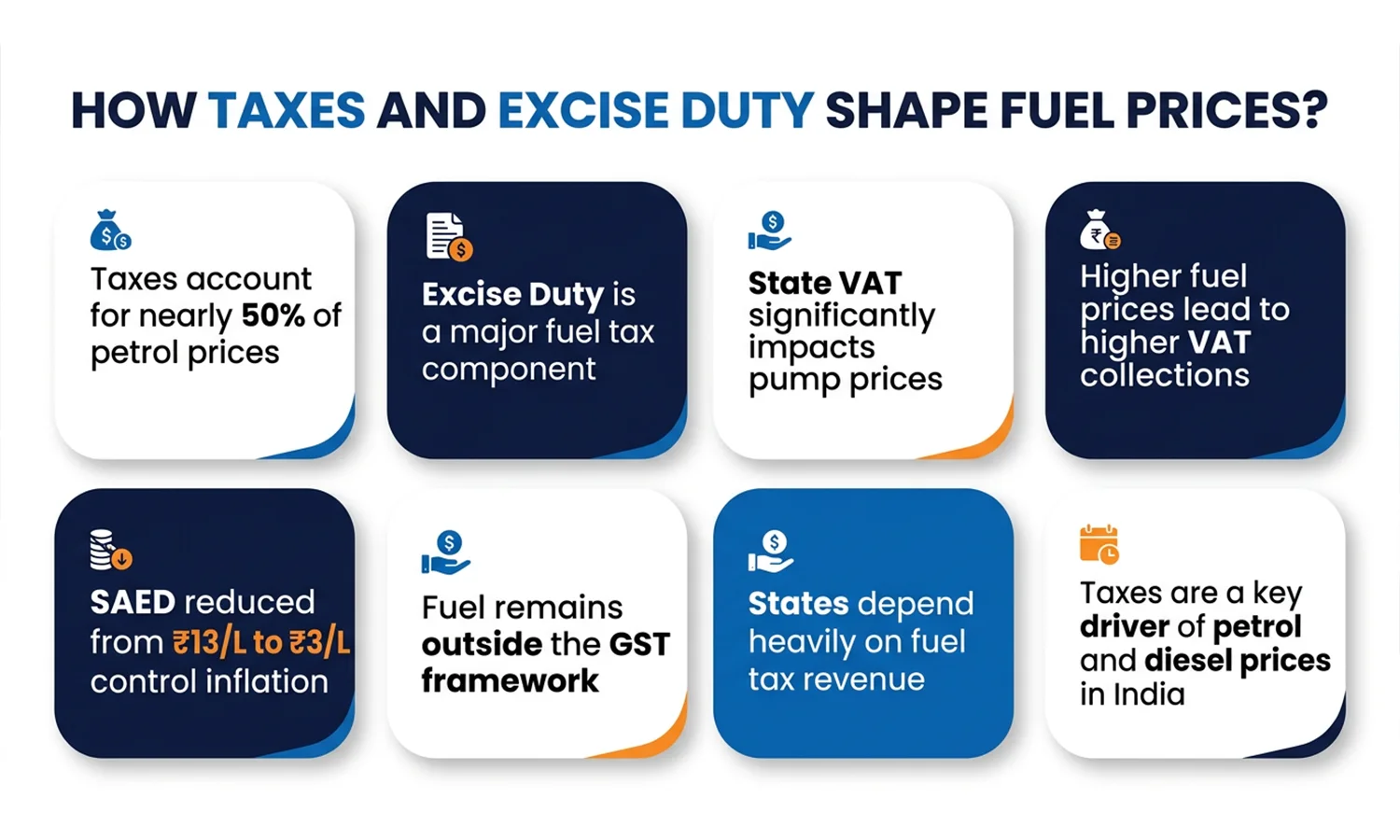
Taxes form one of the largest portions of the petrol price in India.
The central government levies a fixed central excise duty on petrol, while states impose VAT either as a percentage or a flat rate. Together, these taxes often account for nearly half of the final pump price.
The structure currently includes:
- Basic Excise Duty
- Special Additional Excise Duty (SAED)
- Agriculture Infrastructure and Development Cess
- Road and Infrastructure Cess
During the recent crude oil spike triggered by geopolitical tensions, the government reduced SAED from ₹13 per litre to ₹3 per litre to reduce inflationary pressure.
Still, the VAT multiplier effect remains significant. Since state taxes are percentage-based in many regions, any increase in the base fuel value automatically increases state revenue collections as well.
This explains why petrol vs. diesel prices in India vary sharply across regions and why fuel taxation remains politically and economically sensitive.
Fuel also remains outside GST because states rely heavily on fuel taxes as a dependable revenue source. If fuel entered the highest 28% GST slab, retail prices would likely drop sharply, but states would lose substantial revenue streams.
How Ethanol Blending Is Changing India’s Fuel Economy
India’s fuel ecosystem is slowly shifting toward self-reliance through ethanol blending.
The nationwide E20 rollout means petrol sold across India now contains 20% domestically produced ethanol and 80% conventional fossil fuel. This has significantly reduced dependence on imported crude oil.
The ethanol program has already contributed to over ₹1.4 lakh crore in foreign exchange savings and displaced nearly 27.7 million metric tonnes of crude oil imports.
The All India Distillers’ Association (AIDA), representing grain- and molasses-based distilleries, plays an important role in this transition.
AIDA has strongly supported the move toward a multi-feedstock system using maize, damaged grains, and sugarcane by-products. This helps maintain stable ethanol supply while reducing pressure on food-grade resources.
Another major advantage is taxation. Ethanol allocated under the blending program attracts only 5% GST, making it far cheaper than heavily taxed fossil fuels.
As domestic ethanol production grows, India is preparing for higher blending targets under E22, E25, E27, and E30 standards. This shift is expected to reduce long-term pressure on the diesel price and petrol ecosystem by insulating part of the fuel supply from global crude volatility.
Conclusion
The petrol price in India is influenced by far more than just crude oil prices. Taxes, freight charges, currency fluctuations, geopolitical disruptions, and domestic energy policies all shape the final retail fuel price consumers pay every day.
At the same time, India is steadily building a more resilient fuel ecosystem through ethanol blending and domestic production expansion. By reducing imported crude dependency and supporting cleaner alternatives, the country is creating a stronger long-term energy strategy.
At the All India Distillers’ Association, the focus remains on supporting this transition through ethanol capacity expansion, multi-feedstock production, and higher blending readiness that can help India move toward cleaner, more stable, and self-reliant fuel systems.
FAQs
Why is the petrol price in India different in every state?
State governments independently decide VAT rates on fuel. Since VAT structures vary across states, the final retail petrol price changes from one region to another.
Why does the current petrol price in India per liter change daily?
Fuel prices are revised daily based on a rolling average of international crude oil prices and currency exchange movements. Oil marketing companies update retail rates every morning.
What is the role of taxes in fuel pricing?
Central excise duty and state VAT together make up a major part of the retail fuel price. In many cases, taxes contribute nearly 40% to 50% of the final amount paid by consumers.
How does ethanol blending help stabilize fuel prices?
Ethanol blending replaces part of imported crude oil with domestically produced fuel. This lowers foreign exchange outflow and reduces exposure to international crude oil volatility.
Why is petrol outside GST?
Fuel remains outside GST because both the Centre and states depend heavily on fuel taxes for infrastructure spending and public revenue generation.