
As India Energy Week 2026 begins in Goa, one question keeps coming up across sessions and side conversations.
How does India meet the energy needs of a growing population and still reduce pollution in a meaningful way?
For the All India Distillers’ Association (AIDA), this is not a future question. It is already playing out across the country. The answer is simple. Ethanol.
Clean fuel has to work in real life
Energy transition cannot be something that works only on paper or only in big cities. Ethanol has become an alternative fuel for petrol vehicles. It has to work for people who are filling fuel every day, driving long distances and depending on affordable mobility, that’s where ethanol plays an important role in carbon emission reduction in India, which makes it one of the renewable energy sources in India.
Ethanol blending does exactly that. It uses the same fuel stations. It works with vehicles already on the road. People do not need to wait for new infrastructure or make expensive changes. Clean fuel should not feel out of reach, and ethanol keeps it practical, based on the ethanol blending programme.
E20 changed the conversation
India achieved 20 per cent ethanol blending in 2025, five years earlier than planned. That alone tells its own story.
By early 2026, the ethanol blending programme had already replaced around 270 lakh metric tonnes of crude oil imports. It also helped avoid close to 813 lakh metric tonnes of carbon dioxide emissions.
This is not a trial phase anymore. This e20 ethanol blending is a large-scale impact. At India Energy Week this year, the focus has clearly shifted, according to the Biofuel Policy of India. The discussion is no longer about whether ethanol works. It is about how India moves beyond E20.
Using what India already has
India has built a strong base in vehicle manufacturing. Millions of internal combustion engine vehicles are already in use. Replacing all of them overnight is not realistic.
Ethanol offers a faster solution. Flex-fuel vehicles allow existing engines to run cleaner with limited changes. This means better air quality now, not many years later. It also protects manufacturing jobs and investments that already exist.
That balance matters. Climate action should move forward without breaking the systems that support livelihoods. These are some of the ethanol fuel benefits.
The rural link cannot be ignored
Ethanol is not only about fuel. It is also about farmers and rural economies.
https://www.aidaindia.org/sugar-based-ethanol.php
By 2026, more than ₹1.18 lakh crore will have already gone directly to farmers through ethanol procurement. That money stays in rural India. It supports agriculture, local employment and allied industries.
At the same time, the use of surplus grain, sugarcane and agricultural residue ensures that fuel production does not disturb food availability. This balance is critical, especially for a country of India’s size.Supply that runs all year
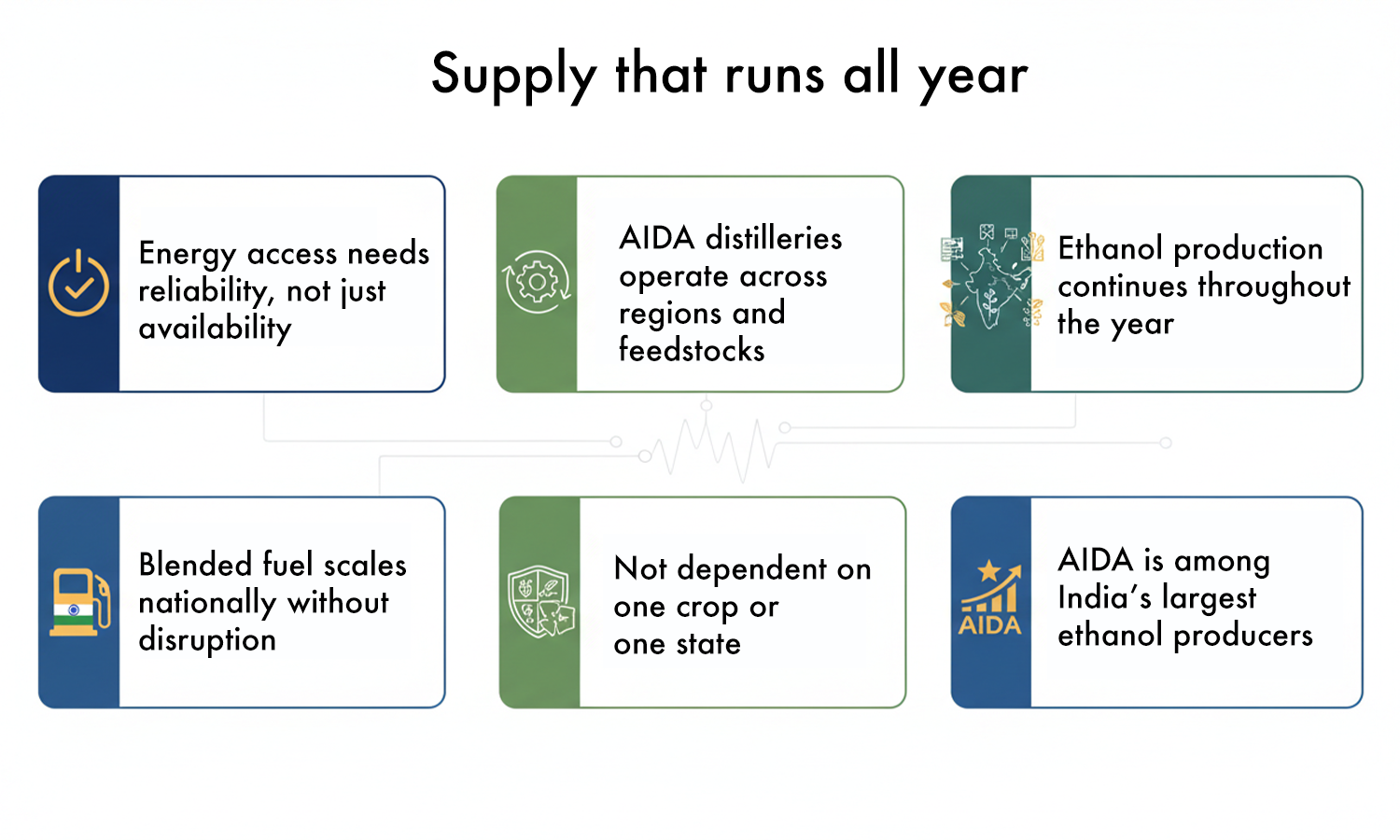
Energy access means nothing without reliability. AIDA’s member distilleries operate across regions and feedstocks. This allows ethanol to be produced throughout the year.
That is why blended fuel has been able to scale nationally. It is not dependent on one crop or one state. It is a system built for consistency, not seasonal spikes. And based on the ethanol production in India, AIDA is one of the largest producers.
Why India Energy Week matters?
India Energy Week 2026 brings global attention to how India is managing its energy transition. Ethanol stands out because it is already delivering results.
Cleaner air, lower import dependence, higher rural incomes and a transition people can actually use today.
For AIDA, the message from Goa is clear. India does not need to choose between growth and sustainability. The smart switch to ethanol shows that both can move together.
That is not a future promise. It is already happening.