
.webp)
Overview
The uses of ethanol reach into more corners of daily life than most people realise. The alcohol in your sanitiser, the solvent in your perfume and a fifth of the petrol in your tank are all the same molecule. That versatility is rare for something so simple. As India's apex distillers' body since 1953, the All India Distillers Association (AIDA) sees the molecule move across all these roles, so here are its real applications, grounded in how it actually behaves.
Why the uses of ethanol start with its chemistry
The uses of ethanol begin with the ethanol formula, C2H5OH. That formula packs a hydroxyl group onto a short carbon chain, and the hydroxyl is what lets the molecule mix with water while the carbon end mixes with oils. So the ethanol formula is not just trivia, it is the reason for everything that follows.
Look at the ethanol structure and the logic gets clearer. The ethanol structure gives one molecule two personalities, water-loving and fuel-like, which is exactly why it can dissolve so many substances. Every use below traces back to that shape.
What is ethanol used for in medicine and homes
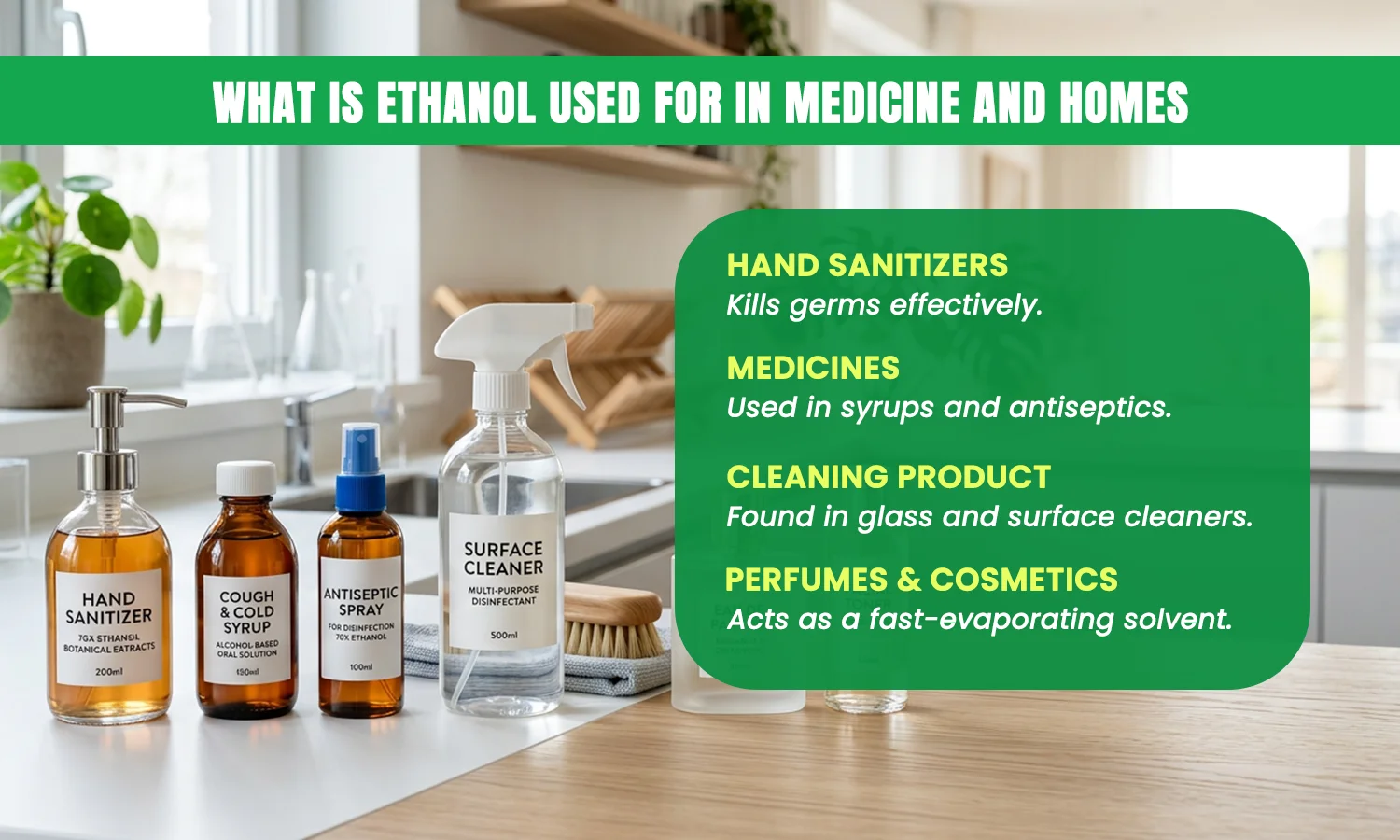
Ask what ethanol is in a pharmacy and the answer is plenty. At around 70 percent strength it is the active ingredient in hand sanitiser, killing germs by breaking down their outer coats. It also serves as a solvent in tinctures, syrups and antiseptics.
Around the home, the question of what ethanol is good for has many answers: cleaning products, glass sprays, perfumes and cosmetics all rely on it. Its ability to dissolve oils and then evaporate cleanly makes it ideal for these jobs.
Industrial and fuel uses of ethanol
Industry leans on the uses of ethanol as a solvent and a feedstock. Paints, inks, varnishes and adhesives all use it, and chemists convert it into acetic acid, ethyl acetate and bio-based plastics. The biggest single application in India today, though, is fuel.
For fuel and industry the alcohol is sold as denatured ethanol, treated with additives so it cannot be drunk. Using denatured ethanol keeps the molecule identical while making misuse impossible, which is why factories and fuel depots prefer it.
Anhydrous and renewable: fuel-grade uses of ethanol
Petrol blending demands anhydrous ethanol, the alcohol with nearly all its water removed to 99.5 percent purity or better. Water and fuel separate, so only anhydrous ethanol can be mixed into petrol without trouble.
Because Indian supply comes from crops rather than oil, these fuel applications count as renewable ethanol uses. Each crop cycle absorbs carbon, which gives renewable ethanol an environmental edge that fossil fuels cannot match.
Transport-grade uses of ethanol on the road

When the alcohol is prepared for vehicles, it becomes transport-grade ethanol, clean and dry enough to travel long distances and fire reliably in engines. The Bureau of Indian Standards sets the specification for transport-grade ethanol, which keeps quality steady across the country.
This fuel role now dominates the uses of ethanol in India, with E20 widely available. Yet the medical, industrial and chemical roles continue alongside it, proving that one simple molecule can serve many masters at once.
KEY TAKEAWAYS
The uses of ethanol span fuel, medicine, sanitisers, solvents, chemicals and potable alcohol.
All of them trace back to the ethanol formula C2H5OH and the dual nature of the ethanol structure.
Industry and fuel use denatured ethanol, treated so it cannot be consumed while staying chemically identical.
Petrol blending requires anhydrous, transport-grade ethanol, dried to 99.5 percent purity or better.
Indian ethanol is renewable because it is made from crops that absorb carbon as they grow.
FREQUENTLY ASKED QUESTIONS
Q1. What are the main uses of ethanol?
The main uses of ethanol are as a vehicle fuel, a hand sanitiser and antiseptic, an industrial solvent in paints and cosmetics, a feedstock for chemicals like acetic acid, and the base for potable alcohol. In India, fuel is now the largest application, with the alcohol mixed into petrol up to 20 percent.
Q2. What is ethanol used for in medicine?
In medicine it is used as the active ingredient in hand sanitisers at around 70 percent strength, as an antiseptic, and as a solvent in tinctures and syrups. Its ability to dissolve substances and evaporate cleanly, which comes straight from the ethanol structure, makes it valuable across many pharmaceutical preparations.
Q3. Why is denatured ethanol used instead of pure ethanol?
Denatured ethanol is used in industry and fuel because it carries small amounts of additives that make it undrinkable, which discourages misuse and can ease taxation. The denaturing does not change the ethanol formula or its solvent and fuel properties, so it works just as well for these uses of ethanol while staying unfit for consumption.
Q4. Are the uses of ethanol environmentally friendly?
Many uses of ethanol are relatively friendly to the environment because Indian supply is renewable, made from crops that absorb carbon as they grow. As a fuel, renewable ethanol mixed into petrol lowers net carbon emissions and cuts crude oil imports. Its role as a solvent also offers a biobased alternative to some petroleum-derived chemicals.
ABOUT AIDA
AIDA, the All India Distillers' Association, has been the voice of Indian distilleries since 1953 and is recognised as the apex national body for ethanol, bioenergy and potable alcohol. Its members hold more than 80 percent of the country's distillation capacity. Read more across the cluster at aidaindia.org.