
Key Takeaways
- Bioethanol fuel is helping India reduce crude oil dependence and foreign exchange outflows.
- Nationwide E20 rollout has strengthened India’s domestic fuel ecosystem.
- Ethanol reduces transport emissions and supports cleaner combustion.
- Rural economies benefit through feedstock demand, distillery expansion, and employment generation.
- AIDA continues to support future-ready fuel systems, including E30 and flex-fuel mobility.
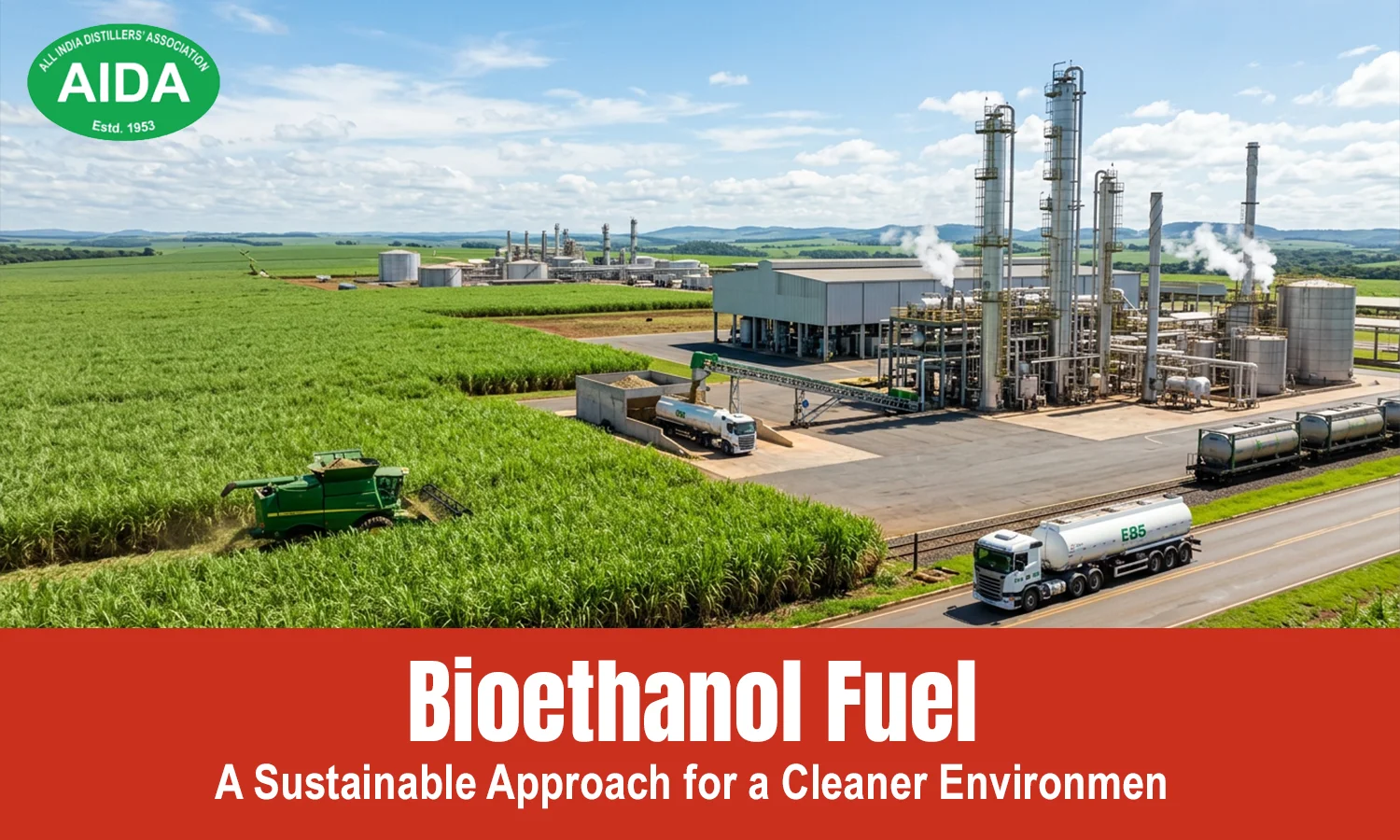
India’s energy transition is no longer limited to reducing emissions alone. The country is also focusing on energy security, domestic fuel production, and long-term economic resilience. At the center of this shift is bioethanol fuel, which has now become a major part of India’s transport and fuel ecosystem.
India achieved a nationwide E20 rollout well ahead of its original target, making ethanol-blended fuel available across retail outlets across the country . This milestone reflects how quickly the country is moving towards cleaner and domestically produced energy alternatives.
The growing role of bioethanol fuel is supported by policy, infrastructure expansion, and rising domestic production capacity. For the All India Distillers' Association (AIDA), this transition is not only about cleaner fuel. It is also about strengthening India’s energy independence and creating long-term value within the country.
Reducing Crude Oil Dependence Through Domestic Bioethanol Production
India imports nearly 85% of its crude oil requirement. This exposes the economy to international price fluctuations, supply chain disruptions, and geopolitical uncertainty. Increasing the use of bioethanol fuel helps reduce this dependence by replacing a portion of imported fossil fuel with domestically produced renewable fuel.
The expansion of bioethanol production has already helped India save more than ₹1 lakh crore in foreign exchange outflows. Instead of sending energy spending outside the country, a growing portion now remains within India’s agricultural and industrial economy.
AIDA has consistently supported a multi-feedstock model to strengthen year-round ethanol supply. This includes:
- sugarcane molasses and syrup
- maize and sorghum
- broken rice
- damaged surplus grains
This diversified system reduces pressure on a single crop while ensuring stable fuel availability throughout the year.
The nationwide adoption of ethanol-blended petrol also means that a portion of every liter of fuel sold today is already domestically produced. This creates a more stable and self-reliant fuel ecosystem for the country.
Bioethanol Fuel and Cleaner Transport Emissions
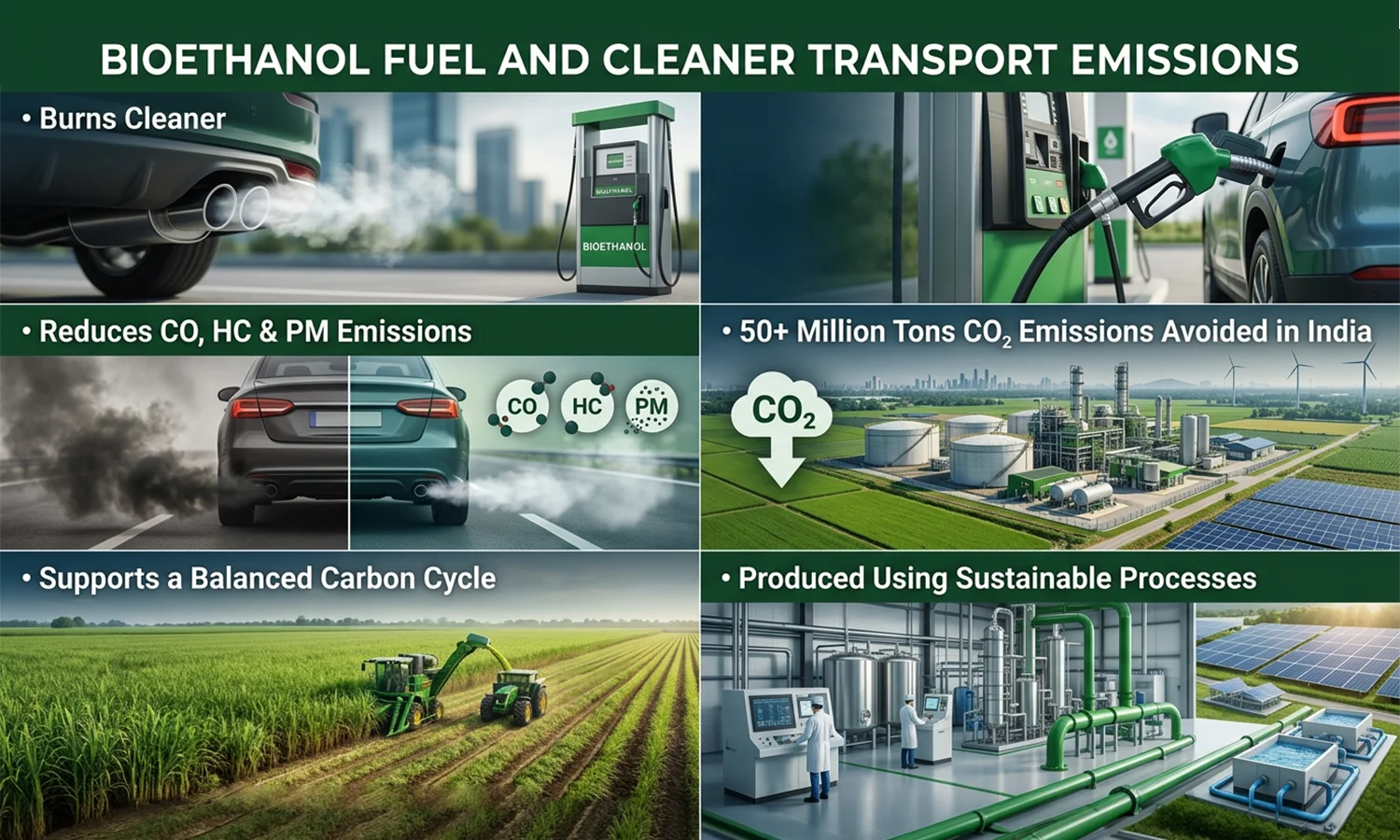
One of the biggest advantages of bioethanol fuel is its role in reducing harmful transport emissions. Ethanol contains oxygen within its chemical structure, allowing engines to burn fuel more completely and efficiently.
The ethanol formula also supports cleaner combustion, helping reduce:
- carbon monoxide emissions
- hydrocarbon emissions
- particulate pollutants
India’s Ethanol Blended Petrol program has already prevented more than 50 million metric tons of carbon emissions from entering the atmosphere.
Another important factor is the carbon cycle linked to bioethanol. Feedstocks such as sugarcane and maize absorb carbon dioxide while growing. When ethanol is used as fuel, a large portion of that carbon is returned to the atmosphere, creating a shorter and more balanced carbon cycle compared to fossil fuels.
Modern distilleries are also improving sustainability within manufacturing itself. Many facilities now operate using:
- Zero liquid discharge systems
- wastewater recycling
- captured commercial CO₂
- biomass-powered operations
This helps ensure that the environmental value of bioethanol fuel continues across the entire production chain.
How Bioethanol Fuel Supports India’s Rural Economy
The impact of bioethanol fuel extends far beyond fuel stations. The program has become deeply connected to India’s agricultural economy and rural industrial growth.
Over the last decade, the ethanol ecosystem has redirected more than ₹90,000 crore into rural India through procurement, distillery expansion, logistics, and agricultural sourcing.
The increasing demand for ethanol feedstock has also created new opportunities for farmers. AIDA has strongly advocated the use of surplus grains, damaged food stocks, and alternate crops to support year-round supply while improving rural income stability.
The growing network of every bioethanol plant also creates employment across
- transportation
- storage
- plant operations
- rural logistics
- engineering services
Another major advantage comes from the circular economy model linked to ethanol manufacturing. Distilleries generate high-protein animal feed known as DDGS, which supports poultry and livestock sectors at competitive costs.
The wider uses of bioethanol are therefore no longer limited to transport fuel alone. The ecosystem now contributes to agriculture, industry, rural employment, and cleaner energy simultaneously.
The Road Ahead for E20, Flex-Fuel Vehicles, and Higher Blends
India’s nationwide E20 rollout is only the beginning of the country’s larger fuel transition. Technical frameworks for E30 and higher ethanol concentrations are already being discussed alongside flex-fuel vehicle adoption.
The All India Distillers' Association has actively supported future-ready fuel systems that can reduce crude dependence even further. Pilot programs for E85 and flex-fuel vehicles are already shaping the next phase of mobility in India.
The growth of ethanol fuel also provides one major advantage over many alternate fuel transitions. Existing fuel stations, storage systems, and transport networks can continue to be used with relatively limited modifications.
At the same time, the industry is preparing for next-generation technologies linked to biofuel development. This includes second-generation ethanol using agricultural residue such as rice straw and biomass waste.
The long-term vision is not limited to transport alone. Discussions around ethanol-based household cooking fuel and advanced feedstock systems are also gaining attention.
As India scales higher blending targets, bioethanol fuel will continue to play a larger role in balancing cleaner mobility, domestic energy production, and long-term economic resilience.
Conclusion
India’s ethanol transition is steadily reshaping how the country approaches energy, agriculture, and environmental sustainability. The role of bioethanol fuel today extends beyond cleaner mobility into areas such as energy security, rural value creation, and long-term economic resilience.
At the All India Distillers' Association, the focus remains on supporting a balanced and scalable ethanol ecosystem built around domestic production, multi-feedstock flexibility, and sustainable industrial growth. As India moves towards higher ethanol blends and future-ready mobility systems, bioethanol is expected to remain an important part of the country’s cleaner and more self-reliant energy future.
FAQs
What is bioethanol fuel?
Bioethanol fuel is a renewable fuel produced using agricultural feedstocks such as sugarcane molasses, maize, broken rice, and surplus grains. It is commonly mixed with petrol to reduce fossil fuel consumption and lower emissions.
What are the main bioethanol uses in India?
The major bioethanol uses in India include transport fuel blending, industrial applications, and future clean cooking fuel systems. Ethanol is currently used extensively under the Ethanol Blended Petrol program.
Is bioethanol fuel environmentally sustainable?
Yes. Bioethanol fuel supports cleaner combustion and lowers greenhouse gas emissions compared to conventional petrol. Modern distilleries also use recycling systems and sustainable manufacturing practices to reduce environmental impact.
How does bioethanol fuel help farmers?
The expansion of bioethanol fuel creates demand for sugarcane byproducts, maize, damaged grains, and surplus agricultural stocks. This helps improve farmer income and supports rural industrial activity across multiple states.
What is the future of bioethanol fuel in India?
India is already preparing for higher ethanol blends such as E30 and flex-fuel vehicle ecosystems. The future of bioethanol fuel is expected to include advanced feedstock systems, second-generation ethanol, and larger domestic fuel substitution.